
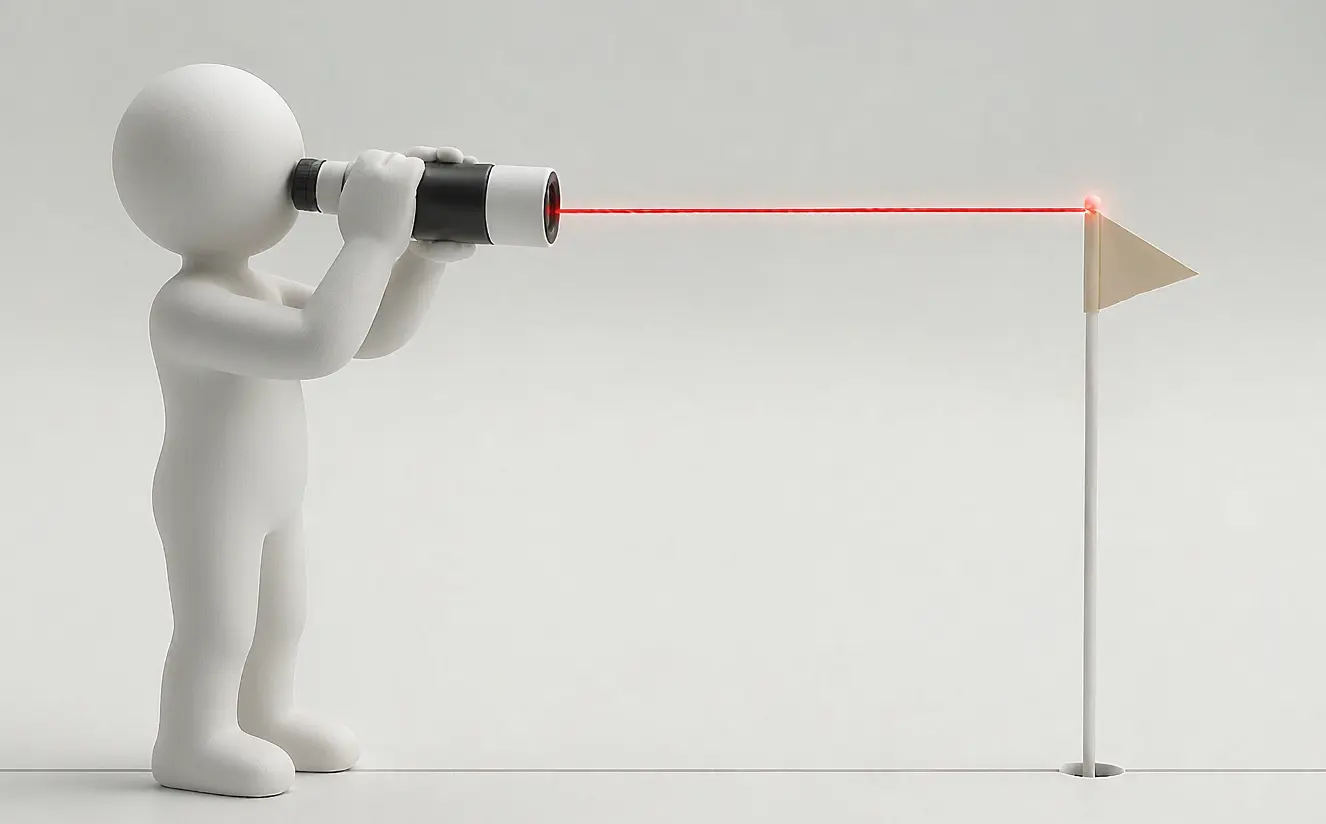
Monocular distance measurement can be achieved by integrating a laser ranging subsystem into an optical monocular device. While the optical system allows users to observe and aim at a target, the laser ranging module measures the distance and sends the result to a display or host processor.
A standard monocular provides optical observation but does not automatically include distance measurement capabilities. To add this function, manufacturers need to integrate additional components, such as a laser transmitter, optical receiver, signal-processing electronics, and a control system.
For manufacturers developing monocular telescopes, thermal imaging monoculars, and other optical observation equipment, understanding how laser ranging works is an important step in product development. This guide explains the measurement principle, key components, integration considerations, and how to select a suitable laser ranging module for an OEM project.
1. What Is Laser-Based Monocular Distance Measurement?
Laser-based monocular distance measurement refers to measuring the distance to a target using laser ranging technology integrated into a monocular optical device.
The system combines two different functions:
- Optical observation: The objective lens and other optical components magnify the target and provide a visible image.
- Laser distance measurement: A laser ranging subsystem transmits laser light toward the target, detects the reflected signal, and calculates the distance.
These functions work together but rely on different components and measurement principles.
In a conventional monocular, the optical system is primarily used for viewing. When distance measurement is required, a laser transmitter, receiver, processing electronics, and related control components must be incorporated into the device.
The physical arrangement depends on the product architecture. Some designs use separate optical paths for viewing, laser transmission, and reception. Other designs use beam-splitting or shared optical components to coordinate the viewing and ranging paths.
For example, certain optical designs use a combined receiving and aiming path while keeping the laser transmitting path independent. Other architectures coordinate the transmitting and receiving paths through additional optical components.
The appropriate arrangement depends on the available installation space, optical design, ranging requirements, and mechanical structure of the host device.
2. How Does Laser Ranging Work in a Monocular?
A laser ranging subsystem measures distance by transmitting laser light toward a target and analyzing the reflected signal received by the device.
One commonly used method is pulsed time-of-flight (ToF) measurement. The process generally involves five stages.
Step 1: The User Observes and Aims at the Target
The user looks through the monocular’s optical system and identifies the object to be measured.
The optical viewing system helps locate the target. Depending on the design, a reticle, aiming indicator, or electronic display may help align the measurement direction with the intended object.
Accurate target alignment is important because the laser measurement should correspond to the object the user intends to measure. If the optical aiming direction and laser ranging direction are not properly aligned, the device may measure a different object.
Step 2: The Laser Transmitter Sends a Pulse
After the user activates the measurement function, the laser transmitter emits a short pulse toward the target.
The transmitter belongs to the laser ranging subsystem rather than the optical magnification system. Its wavelength, pulse characteristics, optical output, and beam divergence depend on the selected ranging design.
When the laser beam reaches the target, part of its optical energy is reflected back toward the device.
Step 3: The Optical Receiver Detects the Reflected Signal
The receiving optics collect a portion of the light reflected from the target.
A photodetector converts the received optical signal into an electrical signal. The receiving electronics then process the signal to identify a valid return and determine its timing.
The strength of the returned signal can be influenced by several conditions:
- Target reflectivity and surface characteristics
- Distance between the device and the target
- Target size and orientation
- Atmospheric conditions
- Optical aperture and receiver sensitivity
- Background light and other sources of interference
This is why the actual measuring performance of a laser rangefinder cannot be judged from its nominal range specification alone. Target conditions and the complete optical and electronic design also matter.
Step 4: The Processor Calculates the Distance
In a pulsed time-of-flight laser rangefinder, the processor determines how long the laser pulse takes to travel to the target and return.
The distance is calculated using the following formula:
Distance = (Speed of light × Time) / 2
The result is divided by two because the measured time includes both the outward and return journeys.
The processor converts the measured round-trip delay into the one-way distance between the monocular and the target.
Pulsed time-of-flight is a common laser ranging method, although not every laser distance measurement system uses the same architecture. The measurement principle should be confirmed from the selected module’s technical documentation.
Step 5: The Distance Is Displayed or Sent to the Host System
After calculating the distance, the ranging electronics provide the measurement result to the device’s control system.
Depending on the product architecture, the result may be:
- Displayed in the monocular’s eyepiece or electronic screen
- Sent to the main processor for further calculation
- Stored for later review
- Transmitted to an external device through a supported communication interface
The user can then view the measured distance alongside the optical observation.
For OEM development, the communication method, data format, and control commands should be coordinated between the laser ranging module and the host device during the design stage.
3. What Are the Main Components Used for Monocular Distance Measurement?
An integrated monocular distance measurement system combines an optical viewing system with a laser ranging subsystem. The exact configuration depends on the product’s mechanical design and intended application.
| Component | Main Function | Key Design Consideration |
|---|---|---|
| Objective lens and eyepiece | Provide optical observation and magnification | Field of view, optical quality, and mechanical space |
| Laser transmitter | Emits laser light toward the target | Wavelength, output characteristics, and applicable safety requirements |
| Receiving optics | Collect reflected laser light | Aperture, alignment, and optical transmission |
| Photodetector | Converts received light into an electrical signal | Sensitivity and compatibility with the ranging architecture |
| Signal-processing circuit | Processes the received signal and determines measurement timing | Signal quality and processing capability |
| Main control unit | Controls measurement commands and communicates with the host system | Firmware, timing, and data handling |
| Display or communication interface | Presents or transmits the distance result | Display arrangement, communication protocol, and user interface |
| Power supply | Provides operating power | Voltage, power consumption, and battery capacity |
These components do not necessarily exist as separate modules in every product.
Some laser ranging modules integrate the transmitter, receiver, processing electronics, and communication interface into one compact assembly. The host manufacturer can then design the optical housing, mounting structure, display, and control logic around the selected module.
This modular approach allows manufacturers to evaluate the ranging subsystem separately while developing the overall monocular product.
4. What Is the Difference Between Optical Magnification and Laser Ranging?
Optical magnification and laser ranging serve different purposes in a monocular device.
Magnification makes a distant object appear larger through the viewing system, while laser ranging measures the distance between the device and the target.
| Comparison | Optical Magnification | Laser Distance Measurement |
|---|---|---|
| Main purpose | Enlarge the viewed image | Determine target distance |
| Main components | Objective lens, optical elements, and eyepiece | Laser transmitter, receiver, detector, and processing electronics |
| Output | Magnified visual image | Numerical distance value |
| Measurement principle | Optical imaging | Analysis of a returned laser signal |
| Requires a ranging subsystem | No | Yes |
| Integration role | Observation and aiming | Distance information |
A monocular with higher magnification does not necessarily have a longer measuring range. Similarly, a laser ranging module with a longer nominal range does not automatically provide better optical magnification.
Manufacturers should therefore evaluate the optical viewing system and laser ranging subsystem as related but separate parts of the overall product.
5. What Should Manufacturers Consider When Integrating a Laser Ranging Module into a Monocular?
For an OEM monocular project, selecting a laser ranging module involves more than checking its maximum measuring distance. The module must fit the optical, mechanical, electrical, and software architecture of the host device.
5.1 Measuring Range and Target Conditions
First, define the intended measurement distance and the types of targets the monocular needs to measure.
A range specification should always be reviewed together with its test conditions. Target reflectivity, target dimensions, atmospheric conditions, and measurement probability can affect the achievable range.
Manufacturers should provide the expected target type and operating environment when requesting a module recommendation.
5.2 Module Dimensions and Installation Space
The available internal space determines which module configurations can be considered.
Before selecting a module, review:
- Maximum allowable length, width, and height
- Mounting points and mechanical references
- Transmitter and receiver aperture positions
- Clearance around optical windows
- Cable routing and connector access
- Space required for the display and main control board
A module that meets the measurement requirements may still be unsuitable if its optical apertures or mounting arrangement cannot fit the host enclosure.
5.3 Optical Alignment
The optical viewing direction and laser ranging direction must be coordinated.
If the laser beam is not aligned with the intended aiming direction, the device may measure a different object from the one shown in the viewing system.
Alignment should be considered at the mechanical design stage and verified after assembly. Manufacturers should also evaluate whether the alignment remains acceptable under the expected operating and environmental conditions.
Depending on the optical architecture, the design may use separate transmitting and receiving paths or optical components that coordinate the ranging and viewing paths.
5.4 Power Supply and Power Consumption
The selected module must operate within the host device’s available power budget.
For a battery-powered monocular, operating current, standby consumption, measurement duty cycle, and power-management requirements can affect overall battery life.
The host system should also account for the module’s required input voltage and startup behavior. These values must be checked against the specific module documentation.
5.5 Communication Interface and Data Processing
The laser ranging module needs a compatible connection to the host processor.
Depending on the module configuration, communication may use interfaces such as UART, TTL, RS232, RS485, or another supported protocol.
Before integration, manufacturers should confirm:
- Electrical signal levels
- Communication protocol and command format
- Measurement result format and units
- Trigger and response timing
- Error and invalid-measurement handling
- Connector and cable requirements
The interface name alone is not enough to establish compatibility. Electrical levels, protocol details, and firmware behavior must also match.
5.6 Operating Environment and Product Reliability
The complete monocular may be exposed to temperature changes, vibration, shock, moisture, dust, and repeated handling.
The required environmental performance should be defined for the finished product. A module’s individual environmental rating does not automatically establish the rating of the assembled monocular.
Manufacturers should verify the complete device under representative operating conditions.
6. How to Select a Suitable Laser Ranging Module for a Monocular Project
A practical selection process starts with the application requirements rather than a specific model number.
Before contacting a module supplier, manufacturers should prepare the following information:
| Requirement | Information to Prepare |
|---|---|
| Application | Handheld monocular, optical observation device, or another optical instrument |
| Measuring range | Minimum and expected maximum target distance |
| Target | Target size, material, reflectivity, and orientation |
| Accuracy | Required measurement accuracy under defined conditions |
| Measurement frequency | How often the device needs to update distance |
| Installation space | Maximum module dimensions and mounting restrictions |
| Power supply | Available voltage and power budget |
| Communication | Required interface and host communication protocol |
| Environment | Operating temperature, vibration, moisture, and dust conditions |
| Project stage | Concept design, prototype, testing, or mass production |
Once these requirements are defined, the manufacturer can compare suitable module configurations and identify design constraints before building the prototype.
It is also useful to evaluate the module in the intended host enclosure. Testing a module separately does not fully represent its performance after installation, because the final optical window, mechanical alignment, power supply, and electronic environment can affect system behavior.
7. Can a Laser Ranging Module Be Customized for Monocular Equipment?
Yes. OEM projects may require a laser ranging module to be matched to the mechanical and electrical requirements of a particular monocular design.
The possible customization scope depends on the module platform and the manufacturer’s engineering capabilities. Project discussions may cover:
- Module dimensions and mechanical mounting
- Measuring range and target conditions
- Communication interface and data output
- Power supply requirements
- Optical aperture and installation arrangement
- Host-system control and integration requirements
Not every parameter can be changed independently. For example, a different measuring range may involve changes to the optical configuration or other parts of the ranging system. Customization should therefore be evaluated as a complete technical requirement rather than a list of isolated specifications.
For a faster technical evaluation, manufacturers should provide a preliminary product drawing, target range, target type, available installation space, power requirements, interface, and expected project quantity.
Working with a laser ranging module supplier that understands OEM integration can help manufacturers evaluate technical compatibility before moving into prototype development and mass production.
Conclusion
Monocular distance measurement combines optical observation with laser-based ranging technology. The optical system helps users locate and aim at a target, while the laser ranging subsystem measures the distance and transfers the result to the host device.
For manufacturers, successful integration depends on more than selecting a module with a suitable measuring range. Optical alignment, installation space, power consumption, communication compatibility, and environmental requirements all need to be considered as part of the complete product design.
By defining these requirements early, OEM manufacturers can identify a suitable laser ranging module and develop a more reliable integration solution for monocular optical equipment.
Frequently Asked Questions
-
What is monocular distance measurement?
Monocular distance measurement is the process of determining the distance between an optical monocular device and a target. When laser ranging technology is integrated, the system uses a laser transmitter and receiver to detect reflected light and calculate the target distance.
-
How does laser distance measurement work in a monocular?
Laser distance measurement in a monocular commonly uses the time-of-flight (ToF) principle. The laser transmitter sends a pulse toward the target, and the receiver detects the reflected signal. The system calculates distance by measuring the pulse’s round-trip travel time.
-
Can a regular monocular measure distance?
A standard optical monocular provides magnified viewing but does not automatically measure distance. To add this function, manufacturers need to integrate a laser ranging subsystem or another distance measurement technology into the device.
-
What is the difference between optical magnification and laser ranging?
Optical magnification enlarges the target image to help users observe distant objects, while laser ranging measures the actual distance to the target. They are separate functions that can work together in a monocular device.
-
What components are needed for laser ranging in a monocular?
A laser-based monocular distance measurement system typically includes a laser transmitter, receiving optics, a photodetector, signal-processing electronics, and a control unit. The complete device also requires an optical viewing system, power supply, and a display or communication interface.
-
What specifications should manufacturers consider when selecting a laser ranging module for a monocular?
Manufacturers should evaluate measuring range, accuracy, measurement frequency, module dimensions, power consumption, communication interface, optical alignment, and operating environment. Target reflectivity and size should also be considered because they can affect actual ranging performance.
-
How is a laser ranging module integrated into a monocular?
A laser ranging module is installed within the monocular housing and connected to the host control system. Integration requires sufficient installation space, proper transmitter and receiver alignment, a compatible power supply, and communication between the module and the host processor.
-
Can a laser ranging module be customized for OEM monocular projects?
Yes. Depending on the module platform, OEM customization may cover mechanical dimensions, mounting arrangements, communication interfaces, power requirements, and measurement specifications. Manufacturers should provide their installation constraints and application requirements to evaluate technical feasibility.
Discuss Your Monocular Laser Rangefinder Project with MESSCAN
Integrating a laser rangefinder into a monocular requires coordination between the optical viewing system, ranging module, mechanical structure, power supply, and host electronics.
MESSCAN works with laser distance measurement module applications and OEM/ODM project requirements. If you are developing a monocular or another optical observation device with distance measurement functionality, share your preliminary technical requirements with our team.
To help evaluate a suitable solution, please include:
- Required measuring range and target type
- Available installation dimensions
- Power supply requirements
- Preferred communication interface
- Operating environment
- Prototype or production quantity
Contact MESSCAN to discuss your laser rangefinder module requirements.