
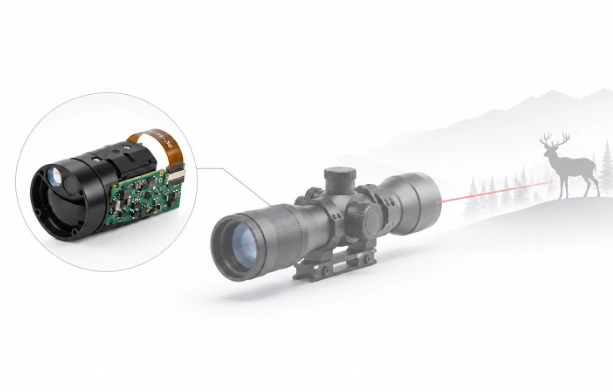
OEM Laser Rangefinder Modules provide equipment manufacturers with a practical way to integrate non-contact distance measurement into optical instruments and other electronic products. From handheld optical devices to outdoor observation equipment and portable electro-optical systems, compact laser ranging modules can add distance measurement capabilities without requiring manufacturers to develop an entire ranging system from scratch.
For optical equipment manufacturers, selecting the right OEM laser rangefinder module involves more than comparing maximum measuring distances. Module dimensions, optical configuration, power consumption, communication interfaces, measurement performance, and mechanical compatibility all influence the final product design.
This guide explains the key considerations when sourcing an OEM laser rangefinder module for optical equipment development, helping product designers and purchasing teams evaluate suitable solutions for their applications.
1. What Is an OEM Laser Rangefinder Module?
An OEM laser rangefinder module is a compact distance measurement unit designed to be integrated into a larger electronic or optical product. Instead of purchasing a complete standalone rangefinder, equipment manufacturers can incorporate the module into their own product housings and electronic systems.
A typical laser rangefinder module combines several functional components:
- Laser transmitter: Emits laser pulses or modulated optical signals toward a target.
- Receiving optics: Collects the reflected optical signal.
- Photodetector: Converts the received optical signal into an electrical signal.
- Signal processing circuit: Processes the received signal and determines the measurement result.
- Control electronics: Manages measurement operations and communication with the host device.
Depending on the product design, the module may provide distance data through UART, TTL, RS232, RS485, CAN, or other supported interfaces.
An OEM laser rangefinder module allows manufacturers to add distance measurement functionality without independently developing the complete laser ranging system.
2. Why Do Optical Equipment Manufacturers Choose OEM Laser Rangefinder Modules?
Developing an optical instrument with integrated distance measurement requires expertise in optical engineering, electronics, mechanical design, and embedded software.
Working with an established laser ranging module supplier can reduce the amount of measurement technology that manufacturers need to develop independently.
Reduced Development Complexity
Developing a complete laser distance measurement system involves optical components, signal processing, calibration, and embedded communication.
An OEM module provides an existing measurement platform that can be evaluated and incorporated into a manufacturer’s product development process.
This allows engineering teams to focus more resources on the overall instrument design, user interface, housing, and application-specific functions.
Compact and Embedded Design
Space is often limited in handheld optical instruments and portable electronic equipment.
Compact laser rangefinder modules can provide distance measurement functionality within a smaller integration space than a complete standalone measuring instrument.
Module dimensions, optical aperture positions, connector placement, and mounting requirements should be evaluated early in the product design process.
Flexible Communication Options
Different optical instruments use different electronic architectures.
A suitable OEM laser rangefinder module should provide a communication interface compatible with the host controller or embedded processing system.
Common interface options include:
- UART / TTL
- RS232
- RS485
- CAN
- USB
The actual interface availability depends on the selected module.
More Efficient Product Development
Using an existing laser ranging platform can help manufacturers shorten the early development process.
Instead of building every measurement component from the beginning, engineering teams can evaluate an existing module, verify its performance under intended conditions, and develop the surrounding product architecture.
3. What Should Manufacturers Consider When Selecting an OEM Laser Rangefinder Module?
Choosing an appropriate module requires evaluating the complete application rather than focusing on one specification.
Measurement Range and Target Reflectivity
The required measurement distance is one of the first parameters to define.
However, the maximum range stated in a datasheet does not necessarily represent the measurement distance achievable under every operating condition.
Target reflectivity, target size, ambient light, atmospheric conditions, and optical configuration can all influence ranging performance.
Manufacturers should provide the supplier with realistic target conditions when evaluating a module.
For example, a module tested against a large, highly reflective target may produce different results when measuring smaller or less reflective objects.
Therefore, maximum range should always be evaluated together with its corresponding test conditions.
Measurement Accuracy and Resolution
Accuracy and resolution describe different aspects of measurement performance.
- Accuracy indicates how close the measurement result is to the actual distance.
- Resolution indicates the smallest measurement increment that the system can represent.
A module with a fine display resolution does not automatically provide the same level of measurement accuracy.
Manufacturers should evaluate the accuracy requirements of the final instrument and confirm the applicable measurement conditions with the module supplier.
Measurement Frequency
Measurement frequency describes how frequently a module can produce distance readings.
The required frequency depends on the intended application and the host system’s data processing requirements.
A higher measurement frequency is not automatically better for every product. It should be selected according to the required response time, processing capacity, power budget, and measurement conditions.
Module Dimensions and Weight
Mechanical compatibility is particularly important for compact optical instruments.
Before selecting an OEM laser rangefinder module, manufacturers should review:
- Overall module dimensions
- Weight limitations
- Mounting structure
- Optical aperture positions
- Connector location
- Available installation space
A module that meets the measurement requirements may still be unsuitable if its mechanical configuration cannot fit the intended product architecture.
Power Supply and Consumption
Power consumption affects battery capacity, operating duration, thermal management, and overall product design.
For portable optical equipment, manufacturers should confirm the module’s supply voltage, operating current, peak current, and power requirements during different operating modes.
These details help determine whether the module is compatible with the host device’s existing power architecture.
Operating Environment
The operating environment should also be considered during module selection.
Temperature variation, vibration, humidity, dust exposure, and mechanical shock may influence the performance and reliability of the complete instrument.
Manufacturers should define the intended operating conditions and confirm whether the selected module and final product enclosure meet the relevant environmental requirements.
4. OEM Integration Considerations for Optical Instruments
Integrating a laser rangefinder module into an optical product requires coordination between the module supplier and the equipment manufacturer’s engineering team.
Several aspects should be reviewed during product development.
Optical Configuration
The transmitter and receiver are essential parts of a laser ranging system.
The optical configuration, aperture arrangement, and mechanical positioning should be evaluated against the available space and optical architecture of the host instrument.
Manufacturers should also confirm the module’s wavelength and applicable laser safety classification before selecting it for a product.
Electronic Communication
The host device must be able to receive and process measurement data from the laser rangefinder module.
Before integration, engineering teams should confirm:
- Communication interface
- Data output format
- Baud rate and communication settings
- Measurement command structure
- Power-on behavior
- Error and status information
Clear communication documentation helps reduce development uncertainty and supports more efficient testing.
Mechanical Compatibility
The module must be securely accommodated within the final product structure.
Dimensions, mounting points, connector orientation, and housing clearance should be checked before finalizing the mechanical design.
For customized projects, manufacturers may discuss mechanical modifications or alternative configurations with the supplier.
System-Level Testing
A module’s datasheet provides essential reference information, but the final instrument should also be evaluated as a complete system.
Testing should consider the actual target conditions, operating environment, power supply, communication stability, and mechanical configuration.
This helps identify differences between standalone module performance and the behavior of the integrated product.
5. How to Evaluate an OEM Laser Rangefinder Module Supplier
Selecting the right supplier is an important part of optical product development.
A suitable supplier should provide more than a product specification sheet.
In-House Research and Development
An experienced engineering team can help evaluate technical requirements, explain module characteristics, and discuss possible solutions for different product designs.
In-house R&D capabilities are particularly useful when standard module configurations do not fully match the customer’s requirements.
Manufacturing and Quality Control
Manufacturing capabilities influence product consistency and long-term supply reliability.
Manufacturers should consider the supplier’s production processes, testing procedures, quality management, and ability to support repeat orders.
Technical Documentation
Useful technical documentation should include:
- Product datasheets
- Mechanical drawings
- Electrical specifications
- Communication protocols
- Operating instructions
- Relevant testing information
Complete documentation makes it easier for engineering teams to evaluate and integrate the module.
OEM and ODM Customization
Different optical instruments have different structural and electronic requirements.
Depending on the supplier’s capabilities, customization discussions may involve module dimensions, connectors, communication interfaces, housing configurations, and other project-specific requirements.
It is important to confirm the feasibility of each requested modification before beginning product development.


6. Why Work with MESSCAN for OEM Laser Rangefinder Modules?
MESSCAN provides laser distance measurement solutions for equipment manufacturers and industrial customers.
With support from Messcan’s laser measurement technology and manufacturing experience, MESSCAN focuses on providing laser ranging products and OEM/ODM support for different measurement applications.
Our capabilities include:
In-House R&D
Engineering support for evaluating measurement requirements and selecting suitable laser ranging solutions.
Manufacturing Experience
Established manufacturing processes and product testing support for laser distance measurement products.
Multiple Communication Interfaces
Available interface options include UART, TTL, RS232, RS485, CAN, and USB, depending on the selected model.
OEM/ODM Support
Project-based discussions covering product configuration, mechanical requirements, interfaces, and other customization needs.
Technical Support
Product documentation and technical communication to support evaluation and integration.
If you are developing a new optical instrument or upgrading an existing product with distance measurement functionality, our team can help evaluate suitable laser rangefinder module options.
7. Request an OEM Laser Rangefinder Module Solution
Selecting an appropriate OEM laser rangefinder module starts with understanding the requirements of your equipment.
To help our engineering team evaluate your project, please prepare the following information:
| Requirement | Information to Provide |
|---|---|
| Application | Type of optical instrument or equipment |
| Measurement range | Required minimum and maximum distance |
| Target conditions | Target size, reflectivity, and operating environment |
| Accuracy | Required measurement accuracy |
| Measurement frequency | Expected measurement update rate |
| Module dimensions | Available installation space |
| Interface | UART, TTL, RS232, RS485, CAN, or other requirements |
| Power supply | Available voltage and power budget |
| Project quantity | Prototype, trial order, or mass production |
Providing these details helps the supplier identify suitable existing models and determine whether customization is required.
Looking for an OEM laser rangefinder module for your next optical equipment project?
Contact MESSCAN to discuss your measurement requirements and explore suitable laser ranging solutions.
Frequently Asked Questions
-
What is the difference between an OEM laser rangefinder module and a handheld laser rangefinder?
An OEM laser rangefinder module is designed for integration into another manufacturer’s product. A handheld laser rangefinder is a complete standalone instrument with its own housing, controls, display, and power system.
-
Can an OEM laser rangefinder module be customized?
Customization depends on the supplier’s engineering and manufacturing capabilities. Common discussion areas include mechanical dimensions, connectors, communication interfaces, housing configurations, and project-specific requirements.
-
Which communication interfaces are available for laser rangefinder modules?
Common interfaces include UART, TTL, RS232, RS485, CAN, and USB. Available options vary by model, so manufacturers should confirm interface compatibility before ordering.
-
How do I choose the right laser rangefinder module for my optical equipment?
Start by defining the required measurement range, target reflectivity, accuracy, measurement frequency, module dimensions, power supply, communication interface, and operating environment. These requirements provide a practical basis for evaluating suitable modules.
-
Can I request samples before mass production?
Sample evaluation can help manufacturers verify measurement performance, mechanical compatibility, and communication behavior before committing to larger production quantities. Sample availability and evaluation arrangements should be confirmed with the supplier.
-
What information should I provide when requesting an OEM quotation?
Provide your application, required measurement range, target conditions, accuracy, frequency, available installation space, communication interface, power requirements, and estimated order quantity. This information helps the supplier evaluate the most appropriate solution.