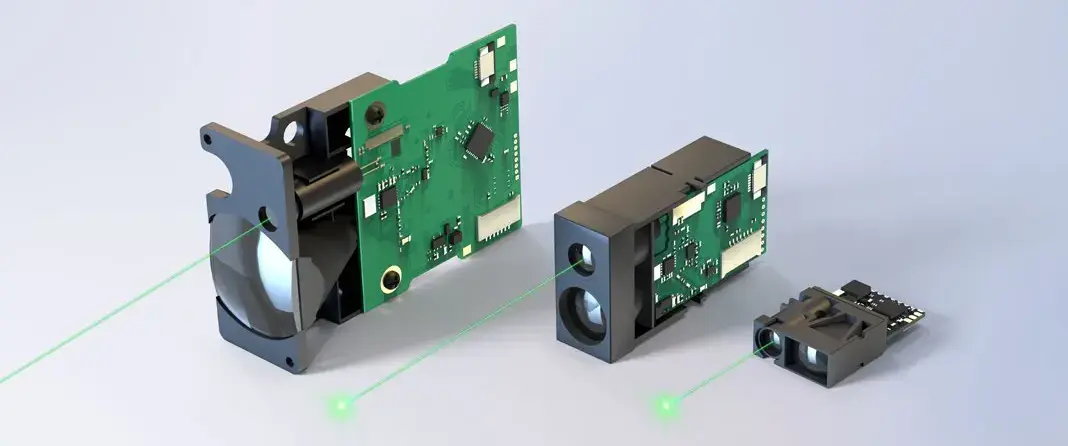
Walk onto a construction site on a bright summer afternoon, point a red laser distance sensor at a target 30 meters away, and try to see the laser spot. Then point a green laser at the same target. The difference can be immediately noticeable.
This is one of the main reasons green laser sensors are popular in surveying, construction, forestry, and other outdoor applications where an operator needs to see the laser point for aiming or alignment.
But visibility is only part of the comparison. When evaluating a Red vs Green Laser Sensor, engineers also need to consider wavelength, optical filtering, target conditions, eye-safety classification, power consumption, module cost, and the actual measurement requirements of the application.
This guide explains the practical differences between red and green laser sensors and helps you determine when the additional cost of a green laser sensor is justified.
Red vs Green Laser Sensor: What Is the Main Difference?
The most obvious difference is the laser wavelength.
Red laser distance sensors commonly operate around 630–690 nm, with 650 nm being a common wavelength for visible red laser modules.
Green laser sensors commonly operate in the 510–550 nm range. Some industrial modules use wavelengths around 520–532 nm.
The human eye is considerably more sensitive to green light than to red light under normal daylight-adapted viewing conditions. This means a green laser spot can appear substantially brighter than a red laser spot when both operate at comparable optical power.
That difference becomes especially important outdoors, where ambient sunlight can make a red laser spot difficult to distinguish from the target surface.
However, a brighter visible spot does not automatically mean higher measurement accuracy.
The measurement performance of a laser distance sensor depends on the complete optical and electronic system, including:
- Laser wavelength
- Optical power
- Beam divergence
- Receiver sensitivity
- Optical filtering
- Target reflectivity
- Ambient light
- Measurement algorithm
- Distance
- Sensor design
Therefore, Red vs Green Laser Sensor should be treated as an application-specific engineering decision rather than a simple comparison of which color is “better.”
Why Green Lasers Are Easier to See Outdoors
The human visual system has its highest photopic sensitivity in the green portion of the visible spectrum, around 555 nm.
As a result, green light generally appears brighter to the human eye than red light at the same optical power.
This creates a practical advantage when an operator needs to visually locate the laser spot.
For example, consider an outdoor alignment task:
Red laser:
The spot may become difficult to distinguish from a bright or reflective target as ambient sunlight increases.
Green laser:
The spot is generally easier for the operator to identify, particularly when working at longer distances or against visually complex backgrounds.
This does not mean that red lasers cannot be used outdoors. They can. The key question is whether human visibility of the laser spot is an important part of the workflow.
For a fixed industrial sensor that is installed once and then operates automatically, the color may have little practical importance.
For a handheld surveying instrument or an outdoor alignment system, it can be much more important.
What Does Laser Color Have to Do With Measurement Accuracy?
This is where the comparison becomes more nuanced.
A common assumption is:
Green laser = higher accuracy.
That is not necessarily true.
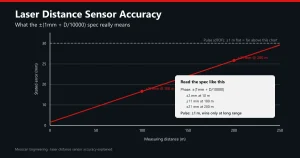
Laser wavelength alone does not determine the accuracy of a distance sensor.
A well-designed red laser sensor can provide excellent measurement accuracy, while a green sensor with a different optical or electronic design may have different performance characteristics.
Accuracy depends on the complete measurement system.
Beam Divergence
Beam divergence determines how quickly the laser beam expands as the distance increases.
A lower-divergence beam can produce a smaller spot at long distances, which can help with aiming and target selection.
However, beam divergence depends on the laser source and optical system, not simply on whether the laser is red or green.
Therefore, when comparing two sensors, check the manufacturer’s actual divergence specification rather than assuming that green automatically produces a smaller spot.
Target Reflectivity
The target surface also has a major influence on measurement performance.
White or highly reflective targets are generally easier to measure than:
- Dark surfaces
- Black materials
- Highly absorbent materials
- Transparent surfaces
- Very reflective surfaces
- Irregular or angled targets
A green laser may make the spot easier for a human operator to see, but that does not eliminate the influence of target reflectivity on the sensor’s receiver.
Optical Filtering
Outdoor laser sensors must distinguish the measurement signal from strong ambient light.
This is particularly important in direct sunlight.
A sensor may use narrow-band optical filtering and signal-processing techniques to improve its ability to detect the intended laser wavelength.
For this reason, two green laser sensors can perform very differently in sunlight even if both use similar wavelengths.
When evaluating a sensor for outdoor use, look beyond the wavelength and check the manufacturer’s stated outdoor range and operating conditions.
When Is a Green Laser Sensor Worth the Premium?
A green laser sensor is particularly worth considering when visual aiming is part of the application.
1. Outdoor Construction
Construction professionals often need to aim a laser at a wall, structural component, or other target in bright daylight.
A more visible green spot can make alignment faster and easier.
2. Surveying
Surveying equipment may require an operator to identify the laser point at relatively long distances.
In this situation, improved visual visibility can reduce the time required to locate the target.
3. Forestry
When measuring trees or other outdoor targets, the laser point may need to be identified against complex natural backgrounds.
Green can provide a practical visibility advantage in these conditions.
4. Outdoor Alignment
Green can also be useful for:
- Equipment alignment
- Structural positioning
- Outdoor installation
- Long-distance marking
- Industrial inspection
The benefit is greatest when the operator must repeatedly identify the laser spot during normal operation.
When Is a Red Laser Sensor the Better Fit?
Green is not automatically the better choice.
Red laser sensors can be a practical option when visual visibility is less important or when the application places greater emphasis on cost, power consumption, or compact OEM integration.
Indoor Applications
In a controlled indoor environment, a red laser spot is usually easy to identify at typical machine or equipment distances.
If the sensor is permanently mounted and does not require frequent visual aiming, the additional visibility of green may provide little practical benefit.
OEM Embedded Systems
Many OEM applications do not require an operator to see the laser during normal operation.
Examples include:
- Conveyor measurement
- Material height detection
- Machine positioning
- Industrial automation
- Equipment monitoring
- Embedded measurement systems
In these applications, engineers should prioritize the required measurement specifications rather than laser color.
Battery-Powered Equipment
Power consumption can become important in handheld or battery-powered products.
The actual power requirement depends on the laser source, driver electronics, optical power, measurement architecture, and operating mode.
Therefore, instead of assuming that green always consumes a specific percentage more power than red, compare the actual current consumption and operating duty cycle of the modules being evaluated.
Red vs Green Laser Sensor: Outdoor Performance
For outdoor applications, visibility and measurement performance should be evaluated separately.
A useful way to think about the problem is:
Human visibility
→ Can the operator clearly see the laser spot?
Measurement performance
→ Can the sensor reliably detect the returned signal?
These are related but different questions.
A green laser can provide a significant advantage for the first question because the human eye is more sensitive to green wavelengths.
The second question depends on the sensor’s complete optical system.
For example, a sensor designed for outdoor use may incorporate:
- Narrow-band optical filters
- High-sensitivity receivers
- Signal-processing algorithms
- Automatic gain control
- Optimized laser power
- Ambient-light rejection
These features can be more important to measurement reliability than laser color alone.
Red vs Green Laser Sensor: Accuracy at Long Range
If your application requires long-distance measurement, do not select a green sensor simply because the green spot is easier to see.
Instead, compare the actual datasheet specifications.
Important parameters include:
| Specification | Why It Matters |
|---|---|
| Measurement range | Determines the usable operating distance |
| Accuracy | Defines how close the measured value is to the actual distance |
| Repeatability | Shows measurement consistency |
| Resolution | Defines the measurement increment or displayed precision |
| Beam divergence | Determines how the beam expands with distance |
| Measurement frequency | Determines how frequently new measurements are produced |
| Response time | Important for moving targets |
| Ambient-light performance | Critical for outdoor operation |
| Target reflectivity | Determines how reliably different surfaces can be measured |
| Optical filter | Helps reject unwanted ambient light |
| Laser wavelength | Affects visibility and optical system design |
This approach prevents a common mistake: treating laser color as a substitute for actual sensor specifications.
Red vs Green Laser Sensor: Power and Cost
Two other factors often influence OEM decisions: power consumption and cost.
Power Consumption
Green and red laser modules can have different power requirements, but there is no universal power-consumption ratio that applies to every sensor.
The total power consumption depends on:
- Laser source
- Optical output power
- Driver circuit
- Receiver electronics
- Processing system
- Measurement frequency
- Operating mode
For a battery-powered product, compare the complete sensor’s supply voltage and current consumption rather than comparing wavelength alone.
Cost
Green laser modules can cost more than comparable red modules because the laser source and optical design may be more complex, depending on the technology used.
However, the actual price difference varies by:
- Laser source
- Optical design
- Measurement range
- Accuracy
- Housing
- Interface
- Production volume
- Customization requirements
For an OEM project, the correct question is therefore not simply:
“Is green more expensive?”
It is:
“Does the additional visibility provide enough value for this application to justify the additional module cost?”
Red vs Green Laser Sensor and Eye Safety
Eye safety should always be evaluated from the actual laser classification and operating conditions, not simply from the color of the laser.
Visible red and green laser products can fall into different laser safety classes depending on their optical output and design.
Similarly, near-infrared pulse laser rangefinders may use wavelengths such as 905 nm and can be designed to meet Class 1 requirements.
When selecting a laser sensor, check:
- Laser class
- Optical output power
- Wavelength
- Intended operating distance
- Applicable safety standards
- Product certification
Do not assume that green is inherently less safe or more safe than red simply because it appears brighter.
Red vs Green Laser Sensor: Which Should You Choose?
Use the following questions during the early design stage.
Does an operator need to see the laser spot?
Yes → Consider green.
If the sensor is frequently aimed manually in bright daylight, green can make the target point easier to identify.
No → Compare the actual sensor specifications.
If the sensor is permanently mounted and operates automatically, laser visibility may have little influence on the final selection.
Is the application mainly indoors?
If yes, a red laser sensor may provide sufficient visibility while offering a simpler or more cost-effective solution depending on the specific product.
Is the application outdoors in direct sunlight?
Compare sensors specifically designed and specified for outdoor operation.
Green may provide a visibility advantage for the operator, but the sensor still needs appropriate optical filtering and signal processing for reliable measurement.
Is the system battery powered?
Compare actual current consumption and duty cycle.
If power consumption is a major constraint, a red module may be preferable if it already satisfies the measurement requirements.
Does the application require long-range measurement?
Do not select based on color alone.
If the required range extends to hundreds or thousands of meters, a pulse ToF sensor may be more appropriate than either a conventional red or green phase sensor.
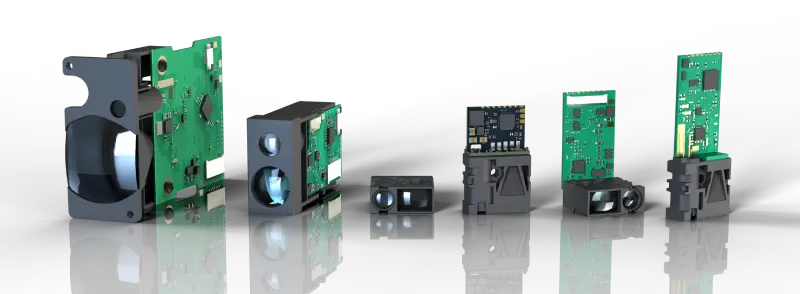
Red vs Green Laser Sensor: Quick Comparison
| Factor | Red Laser Sensor | Green Laser Sensor |
|---|---|---|
| Typical visible wavelength | Around 630–690 nm | Around 510–550 nm |
| Human visual visibility | Good, but weaker in bright daylight | Generally easier to see |
| Outdoor aiming | Suitable, depending on conditions | Often advantageous |
| Indoor aiming | Usually sufficient | Usually provides little additional benefit |
| Measurement accuracy | Depends on sensor design | Depends on sensor design |
| Outdoor measurement | Depends on optical design | Depends on optical design |
| Power consumption | Model dependent | Model dependent |
| Cost | Often lower | Often higher |
| Best fit | Indoor OEM and cost-sensitive applications | Outdoor aiming and alignment applications |
The table is a starting point only. Actual performance should always be verified against the specifications of the individual sensor model.
A Practical OEM Selection Example
Suppose you are designing an OEM distance measurement device for a construction application.
The system needs to measure targets at 30–50 m in daylight, and the operator must manually aim the sensor.
In this case, the visibility of the laser spot is an important requirement.
A green laser sensor may therefore provide a practical advantage because the operator can identify the aiming point more easily.
Now consider a different system:
A fixed sensor is mounted above an indoor conveyor and continuously measures material height.
The operator does not need to see the laser during normal operation.
In this case, the decision should focus on:
- Measurement accuracy
- Measurement range
- Measurement frequency
- Target characteristics
- Interface
- Power consumption
- Cost
- Mechanical integration
Laser color may have little impact on the overall system performance.
This illustrates the central principle of Red vs Green Laser Sensor selection:
Choose the laser color according to the application workflow, not simply according to which color appears brighter.
Final Decision: When Is the Green Premium Worth It?
A green laser sensor can be worth the additional cost when human visibility in bright environments directly affects how the product is used.
Green is particularly useful for:
- Outdoor construction
- Surveying
- Forestry
- Manual alignment
- Long-distance visual aiming
- Outdoor inspection
Red can be a practical choice when:
- The application is primarily indoors
- The sensor is permanently mounted
- Visual aiming is rarely required
- Power consumption is tightly constrained
- Cost is a major OEM consideration
- The red module already meets the required specifications
For measurement performance, however, wavelength should never be considered in isolation.
The best Red vs Green Laser Sensor choice depends on the complete system: range, accuracy, target reflectivity, ambient light, optical filtering, measurement speed, power, interface, and operating environment.
Need Help Selecting a Red or Green Laser Sensor?
If you are developing an OEM product and are deciding between a red and green laser distance sensor, prepare the following information:
- Required measurement range
- Required accuracy
- Indoor or outdoor environment
- Ambient-light conditions
- Target material and reflectivity
- Whether the operator needs to see the laser spot
- Required measurement frequency
- Power and interface requirements
With these parameters, a sensor manufacturer can recommend suitable red or green modules for evaluation.
For OEM projects, it is also useful to request samples and test them under the actual lighting, target, distance, and installation conditions of the final application.
The right laser wavelength is not simply the one that looks brightest. It is the one that provides the right combination of visibility, measurement performance, integration requirements, and total system cost.