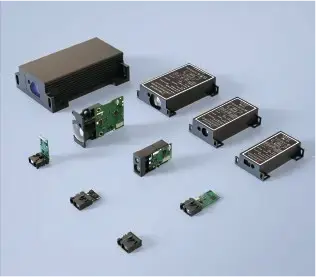
When you specify a laser distance sensor for an OEM integration, one of the first decisions you need to make is Phase vs Pulse Laser Distance Sensor technology: phase-shift or time-of-flight (pulse). This choice can affect measurement range, accuracy, response time, environmental performance, power consumption, cost, and the overall design of your system.
Choose the wrong technology, and you may pay for measurement range or performance that your application does not require—or discover that the sensor cannot deliver the accuracy, range, or measurement speed your system needs.
This guide provides a practical comparison of phase-shift and pulse laser distance sensors for factory automation, robotics, surveying, UAVs, infrastructure monitoring, and other OEM applications. By the end, you will understand how the two technologies work, where each performs best, and which specifications to evaluate when selecting a laser distance sensor module.
What Do Phase and Pulse Laser Distance Sensors Actually Mean?
Both technologies use laser light to measure distance, but they determine distance using different measurement principles.
Phase-Shift Laser Distance Sensors
A phase-shift laser distance sensor continuously emits a modulated laser signal toward the target. The reflected signal returns to the sensor with a phase difference relative to the transmitted signal.
The electronics analyze this phase difference to determine the distance to the target.
Because phase differences can be measured very precisely, phase-shift sensors are commonly used when millimeter-level measurement accuracy and stable short-to-medium range measurement are important.
Typical applications include:
- Factory automation
- Robotic positioning
- Conveyor monitoring
- Machine positioning
- Material height measurement
- Indoor logistics
- Equipment calibration
- OEM measurement systems
Phase technology is particularly attractive when the measurement range is relatively short and accuracy is more important than maximum range.
Pulse Laser Distance Sensors
Pulse laser distance sensors, also called time-of-flight (ToF) laser distance sensors, determine distance by measuring the time required for a laser pulse to travel to the target and return to the receiver.
The basic relationship is:
Distance = (Time × Speed of Light) / 2
The factor of two accounts for the outgoing and returning paths.
Pulse measurement is well suited to applications requiring longer measurement distances. Depending on the optical system, laser wavelength, target reflectivity, atmospheric conditions, and electronics, pulse-based modules can measure from hundreds of meters to several kilometers.
Typical applications include:
- Long-range outdoor measurement
- UAV and drone ranging
- Surveying
- Forestry
- Infrastructure monitoring
- Traffic and vehicle measurement
- Security and perimeter monitoring
- Port and ship positioning
- Outdoor target ranging
The key advantage of pulse technology is therefore not simply “higher accuracy” or “higher speed,” but its ability to extend the practical measurement range.
Phase vs Pulse Laser Distance Sensor: 5 Key Differences
When comparing Phase vs Pulse Laser Distance Sensor technology, engineers should evaluate more than the nominal range listed on a datasheet.
| Specification | Phase-Shift Sensor | Pulse / ToF Sensor |
|---|---|---|
| Typical measurement range | Short to medium | Medium to very long |
| Typical accuracy | Millimeter-level | Commonly centimeter- to meter-level depending on model and range |
| Measurement principle | Phase difference of modulated light | Time of flight of a laser pulse |
| Typical applications | Factory automation, robotics, indoor OEM equipment | Outdoor ranging, surveying, UAVs, infrastructure |
| Ambient-light requirements | Model and target dependent | Model and optical design dependent |
| Measurement speed | Can be high | Varies significantly by module |
| Power requirements | Often suitable for embedded systems | Depends on range, pulse power, and electronics |
| Typical wavelength options | Visible or near-infrared | Commonly 905 nm; other wavelengths are also used |
| Maximum range | Generally more limited | Can extend to hundreds or thousands of meters |
These are general engineering characteristics rather than fixed rules. Actual performance depends on the optical design, target reflectivity, laser power, wavelength, receiver sensitivity, measurement algorithm, and environmental conditions.
The practical takeaway
For short-range, high-precision measurement, phase-shift technology is often a strong candidate.
For long-range measurement, particularly outdoors, pulse ToF technology is often more appropriate.
However, applications can overlap. In the overlap range, the final choice should be based on accuracy, target characteristics, environmental conditions, measurement speed, interface, power consumption, and total system cost.
Where Phase-Shift Laser Distance Sensors Fit Best
Phase-shift laser distance sensors are widely used in applications where precise and repeatable distance measurement is more important than maximum range.
Factory Automation
Manufacturing equipment often requires continuous distance information for positioning, alignment, level monitoring, and process control.
Typical examples include:
- Conveyor belt height monitoring
- Material position detection
- Machine positioning
- Automated equipment alignment
- Robotic workstation measurement
- Production-line inspection
Robotics and AGV/AMR Systems
Robotic systems can use laser distance sensors for positioning and object detection.
For OEM designers, the combination of compact dimensions, millimeter-level accuracy, and digital communication can make a phase sensor easier to integrate into a robot or controller.
However, the required measurement accuracy should always be determined from the actual positioning tolerance of the system rather than assuming that the highest available sensor accuracy is necessary.
Industrial Level and Height Measurement
A laser distance sensor can measure the distance between the sensor and a material surface without physical contact.
This is useful for:
- Material height measurement
- Tank and bin monitoring
- Pallet detection
- Stack height measurement
- Conveyor monitoring
For these applications, the target surface and reflectivity should be considered carefully because dark, reflective, transparent, or irregular targets can affect measurement performance.
Example: Compact OEM Integration
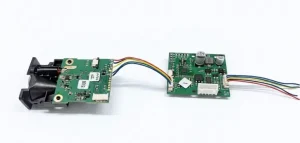
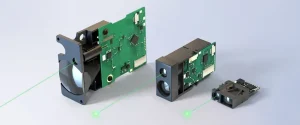
The Meskernel LDL-S series is an example of a compact laser distance sensor designed for embedded measurement applications. Depending on the specific model and configuration, the series can provide millimeter-level measurement performance with digital interfaces suitable for OEM integration.
When evaluating a compact sensor for a new product, engineers should check the exact model’s:
- Measurement range
- Accuracy specification
- Measurement frequency
- Dimensions
- Power supply
- Communication interface
- Operating temperature
- Target requirements
The exact specification should always be taken from the datasheet of the selected model rather than assumed from the product family.
Where Pulse Laser Distance Sensors Fit Best
Pulse laser distance sensors become increasingly useful as the measurement distance increases.
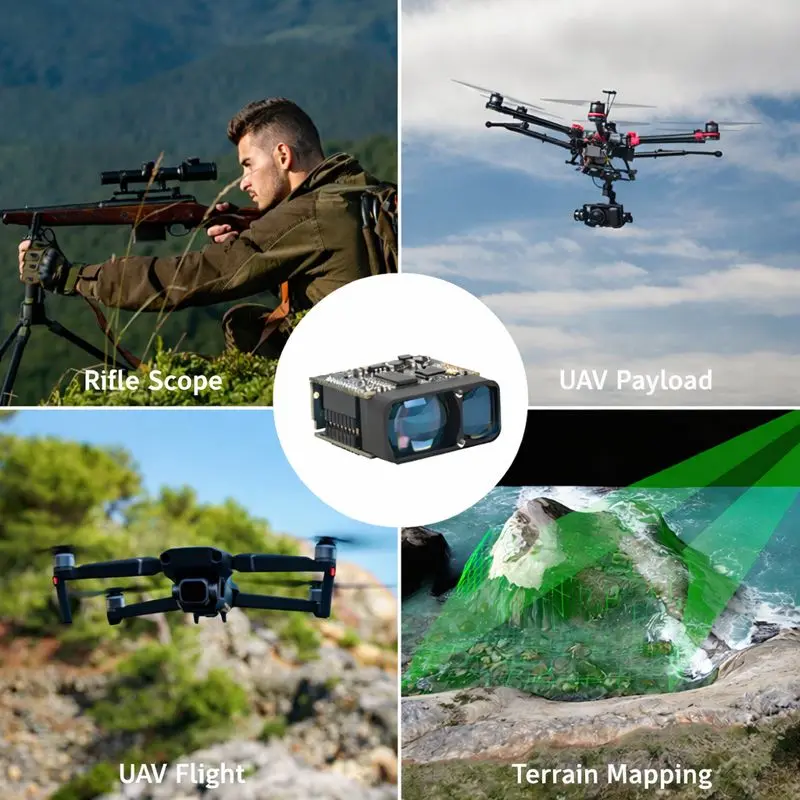
UAV and Drone Ranging
Weight and size are critical for UAV applications.
A compact pulse laser rangefinder can provide distance information for:
- Altitude measurement
- Terrain ranging
- Target distance measurement
- Obstacle detection
- Payload positioning
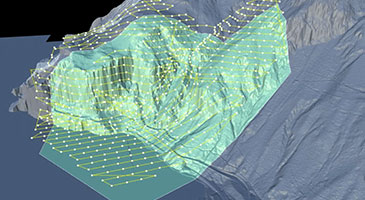
- Aerial surveying
For UAV integration, engineers should consider not only range but also module weight, power consumption, communication interface, measurement frequency, and vibration resistance.
Outdoor Surveying
Surveying applications can require measurements over hundreds or thousands of meters.
Pulse ToF technology is well suited to long-range applications because the measurement principle directly determines distance from the travel time of the laser pulse.
For outdoor use, the designer should also consider:
- Target reflectivity
- Atmospheric conditions
- Sunlight
- Measurement angle
- Required accuracy
- Maximum operating range
Forestry and Tree Height Measurement
Laser ranging is useful for estimating tree height, canopy distance, and other outdoor dimensions.
Long-range pulse modules can be integrated into handheld, tripod-mounted, or binocular-style equipment where the measurement target may be hundreds of meters away.
Infrastructure Monitoring
Long-range laser distance sensors can also be integrated into monitoring systems for bridges, buildings, towers, cranes, and other large structures.
For these applications, the important specifications may include long-term stability, measurement repeatability, communication interface, environmental protection, and continuous operating capability.

How to Choose When Both Technologies Can Work
The decision becomes more complicated when both phase and pulse sensors can technically cover the required distance.
Instead of choosing based only on maximum range, start with these five questions.
1. What Accuracy Does the Application Actually Require?
Accuracy should be defined by the system’s measurement tolerance.
For example:
- ±1 mm requirement → consider a high-precision phase sensor
- ±10 mm requirement → compare available phase and pulse options
- ±100 mm or looser requirement → long-range pulse technology may provide sufficient performance
Do not confuse resolution with accuracy.
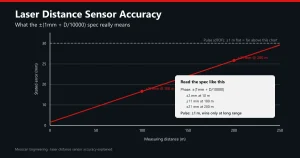
A sensor may display measurements to 1 mm resolution without actually achieving ±1 mm accuracy.
Always check the manufacturer’s accuracy specification and whether it varies with measurement distance.
2. What Is the Required Measurement Range?
Start with the minimum and maximum distance that the sensor must reliably measure.
Do not select a sensor simply because its advertised maximum range is much greater than your application requirement.
For example, if an OEM system only needs to measure 20 m indoors, a kilometer-class rangefinder may add unnecessary cost and power requirements.
Conversely, if the target is hundreds of meters away, a short-range phase sensor may not provide sufficient measurement capability.
3. What Is the Operating Environment?
Environmental conditions can strongly affect laser measurement.
Consider:
- Indoor or outdoor installation
- Direct sunlight
- Target reflectivity
- Rain, dust, fog, or snow
- Measurement angle
- Background objects
- Temperature
- Required IP protection
A pulse sensor is not automatically immune to environmental effects, and a phase sensor is not automatically unsuitable for outdoor use. The actual sensor specification and optical design should be evaluated for the application.
4. What Measurement Speed Does the System Need?
Measurement frequency and response time are related but are not exactly the same specification.
If your control system requires frequent distance updates, check the sensor’s:
- Measurement frequency
- Response time
- Output latency
- Filtering behavior
- Communication speed
Some phase-based modules can provide high measurement rates, while certain pulse modules are optimized primarily for long-range measurement. However, high-frequency pulse laser modules are also available, so the specific product specification matters more than the technology name alone.
5. What Interface and Mechanical Constraints Apply?
For OEM integration, electrical and mechanical compatibility can be just as important as optical performance.
Check whether the module supports the interface required by your controller, such as:
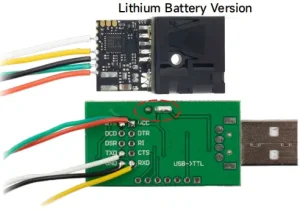
- UART / TTL
- RS232
- RS485
- CAN
- USB
- Modbus
Also verify:
- Module dimensions
- Mounting points
- Connector type
- Supply voltage
- Current consumption
- Housing requirements
- Operating temperature
- IP rating
A technically suitable sensor may still be difficult to integrate if its mechanical or electrical interface does not match the existing system.
Common Mistakes When Selecting Phase vs Pulse Laser Distance Sensors
Choosing Maximum Range Instead of Required Performance
A common mistake is to select a sensor based on the largest range number on the datasheet.
If the application requires only 10–30 m measurement but needs ±1 mm accuracy and fast response, maximum range may be far less important than precision and update rate.
Assuming Pulse Always Means Outdoor
Pulse ToF sensors are commonly used outdoors, but the technology itself does not determine whether a sensor is suitable for a particular environment.
Target reflectivity, optical design, wavelength, receiver sensitivity, and environmental specifications all matter.
Assuming Phase Is Only for Indoor Applications
Phase-shift sensors are frequently used indoors and in controlled industrial environments, but application suitability depends on the individual sensor.
If outdoor operation is required, evaluate the manufacturer’s stated outdoor range and ambient-light performance instead of excluding phase technology automatically.
Confusing Accuracy, Resolution, and Repeatability
These three specifications describe different aspects of measurement performance.
Resolution describes the smallest measurement increment the system can distinguish or report.
Accuracy describes how close the measured value is to the actual distance.
Repeatability describes how consistently the sensor produces the same measurement under repeated conditions.
For OEM engineering, all three can matter.
Ignoring the Laser Wavelength
Laser wavelength affects visibility, optical design, detector selection, and eye-safety considerations.
For example, visible red lasers can be useful when an operator needs to see the aiming point, while near-infrared wavelengths such as 905 nm are commonly used in compact ranging modules.
The wavelength should therefore be selected according to the optical, safety, environmental, and application requirements—not simply because one wavelength is commonly used.
Phase vs Pulse Laser Distance Sensor: A Practical Selection Guide
The following simplified decision process can help during the early stage of an OEM project:
Need millimeter-level accuracy at a relatively short distance?
→ Start by evaluating phase-shift laser distance sensors.
Need hundreds of meters or kilometer-level measurement?
→ Start by evaluating pulse ToF laser distance sensors.
Need outdoor measurement in strong ambient light?
→ Compare sensors specifically rated for the required outdoor conditions rather than selecting by technology alone.
Need very high measurement frequency?
→ Compare the actual measurement frequency and response-time specifications of available modules.
Need a compact embedded module?
→ Compare dimensions, weight, power consumption, communication interface, and mounting requirements in addition to optical specifications.
The right technology is ultimately the one that satisfies the complete system requirement—not simply the one with the longest range or highest accuracy.
Phase vs Pulse Laser Distance Sensor: Which Should You Choose?
There is no universal winner between phase-shift and pulse laser distance measurement.
The appropriate technology depends on the application’s combination of range, accuracy, measurement speed, environment, target characteristics, interface, power consumption, and mechanical constraints.
As a general starting point:
- Choose phase-shift technology when high precision and short-to-medium measurement distances are the primary requirements.
- Choose pulse ToF technology when long measurement distances are a primary requirement.
- For applications in the overlap range, compare actual datasheet performance rather than choosing based only on the measurement principle.
- For OEM integration, evaluate the complete module—including communication interface, dimensions, power, environmental rating, and customization options.
The most effective way to select a laser distance sensor is to define the application requirements first and then match the sensor technology and model to those requirements.
Need Help Selecting a Laser Distance Sensor?
If you are developing an OEM product and are unsure whether a phase-shift or pulse laser distance sensor is suitable, prepare these five parameters before contacting a sensor manufacturer:
- Required measurement range
- Required accuracy
- Operating environment
- Required measurement frequency or response time
- Communication interface
With these parameters, an engineering team can quickly narrow down the appropriate laser distance measurement technology and identify suitable modules for evaluation.
For OEM projects, also consider whether the supplier can provide sample testing, interface customization, firmware support, mechanical customization, and volume production.
Choosing the right technology at the beginning of the design process can reduce unnecessary cost, simplify integration, and prevent performance limitations later in the product development cycle.