Laser Distance Sensor Accuracy: A Complete Guide
Laser distance sensor accuracy is one of the most important specifications when selecting a sensor for industrial automation, robotic positioning, displacement monitoring, or long-range measurement. However, laser distance sensor accuracy is not always a single fixed number. Many industrial laser distance sensors specify their measurement error using both a constant error and a distance-dependent term.
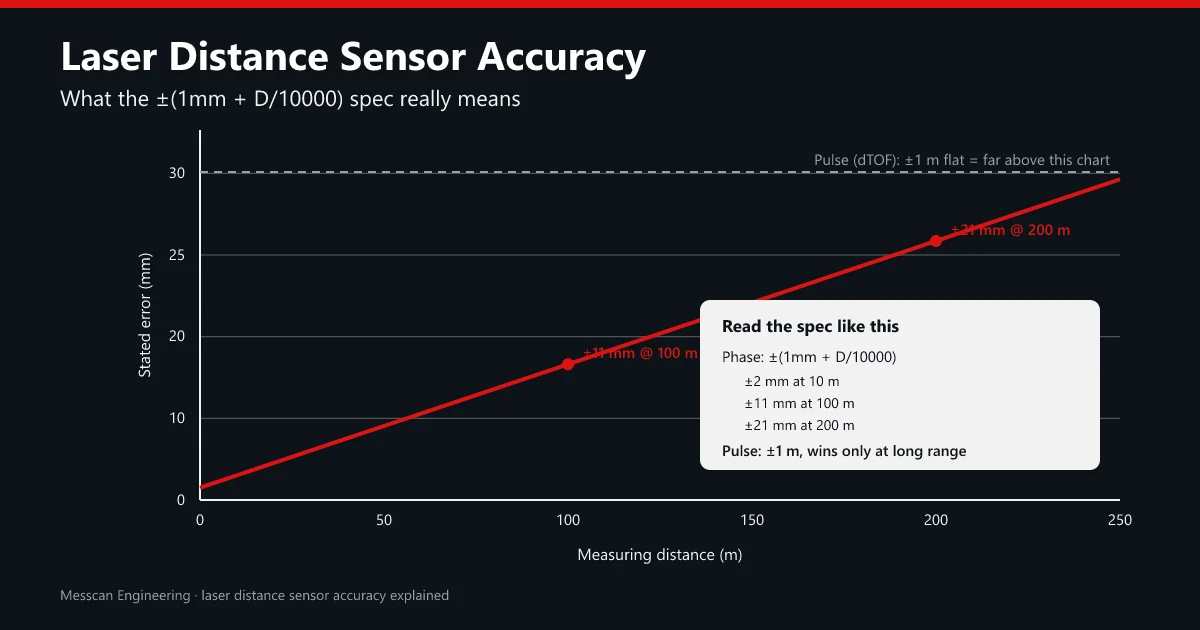
For example, a sensor with a stated accuracy of ±(1 mm + D × 1/10000) has a different allowable measurement error at 10 meters than at 100 meters. Understanding this formula helps engineers evaluate laser distance sensor accuracy at different measuring distances and avoid selecting a sensor that cannot meet their application requirements.
This guide explains how laser distance sensor accuracy is specified, how to calculate measurement error, how phase-shift and pulse sensors differ, and which real-world factors affect measurement performance. It also provides practical guidance for choosing an industrial laser distance sensor based on your required accuracy, measuring range, target surface, and operating environment.
What Is Laser Distance Sensor Accuracy?
Laser distance sensor accuracy describes how closely a measured distance matches the actual distance under specified measurement conditions. It indicates the potential measurement error, rather than the smallest displayed increment or the consistency of repeated readings.
Three specifications are particularly important when evaluating laser distance sensor accuracy:
- Accuracy: How close the measured value is to the actual distance.
- Resolution: The smallest change in distance that the sensor can distinguish or display.
- Repeatability: How consistently the sensor produces similar readings when measuring the same target under the same conditions.
These specifications are related but not interchangeable. A laser distance sensor may display measurements in 0.1 mm increments without achieving an accuracy of ±0.1 mm. Similarly, a sensor may produce highly consistent readings while maintaining a systematic offset from the actual distance.
When comparing laser distance sensor accuracy specifications, engineers should evaluate all three parameters instead of relying on resolution alone.
How to Calculate Laser Distance Sensor Accuracy
Many industrial laser distance sensors express their measurement error using a formula such as:
±(1 mm + D × 1/10000)
In this formula, D represents the measured distance, expressed in the same unit used by the proportional term. When D is expressed in millimeters, the formula combines a constant error of 1 mm with an additional error equal to 0.01% of the measured distance.
The formula contains two components:
1. Constant error: ±1 mm
The constant term represents the fixed component of the stated measurement error. It remains 1 mm regardless of whether the target is close to the sensor or farther away.
2. Distance-dependent error: D × 1/10000
The proportional term increases with measuring distance. At 10 meters, this component contributes 1 mm; at 100 meters, it contributes 10 mm.
This is why laser distance sensor accuracy must always be evaluated at the actual working distance rather than at a single point in the sensor’s measuring range.
Laser Distance Sensor Accuracy at Different Distances
Consider an industrial laser distance sensor with a specified error of ±(1 mm + D × 1/10000) and a measuring range that covers the distances in the following examples.
| Measuring distance | Constant term | Distance-dependent term | Total stated error |
|---|---|---|---|
| 10 m | ±1 mm | ±1 mm | ±2 mm |
| 100 m | ±1 mm | ±10 mm | ±11 mm |
| 200 m | ±1 mm | ±20 mm | ±21 mm |
At 10 meters, the stated error is ±2 mm. At 100 meters, it increases to ±11 mm, and at 200 meters, it reaches ±21 mm.
These figures illustrate how laser distance sensor accuracy specifications work. The increasing error does not automatically mean that the sensor has deteriorated. Instead, the distance-dependent component contributes more to the total error as the target moves farther away.
For applications requiring precise positioning over a short distance, a few millimeters of error may be acceptable. For robotic assembly or precision alignment, the same error may exceed the application’s tolerance. Engineers should calculate the expected error at the maximum operating distance before selecting a sensor.
Phase vs. Pulse: Which Laser Distance Sensor Offers Better Accuracy?
The measurement principle is a major consideration when choosing laser distance sensor accuracy for a particular application. Phase-shift and pulse-based sensors use different measurement methods and are generally suited to different combinations of range and precision.
For a more detailed comparison of their operating principles, see our guide to phase vs. pulse laser distance sensors.
Phase-Shift Laser Distance Sensors for High Accuracy
Phase-shift sensors measure the phase difference between transmitted and reflected modulated light. This method can support millimeter-level distance measurement, making phase-based laser distance sensors suitable for applications where measurement precision is a priority.
For example, a red-beam phase sensor with a specified error of ±(1 mm + D × 1/10000) has a calculated error of ±2 mm at 10 meters and ±11 mm at 100 meters.
The main advantage is the ability to measure small distance changes within a suitable operating range. Applications include robotic positioning, industrial automation, crane positioning, and selected displacement-monitoring tasks.
However, phase-shift measurement has practical range limitations. Phase ambiguity, signal conditions, and the sensor’s measurement design affect how far it can measure reliably. The actual performance depends on the specific model and its stated operating conditions.
Pulse Laser Distance Sensors for Long-Range Measurement
Pulse-based sensors use direct time-of-flight measurement. They calculate distance from the time required for a laser pulse to travel to the target and return to the receiver.
This method is useful for long-range applications, including surveying, outdoor monitoring, and distance measurement from drones or other mobile platforms.
For example, the TS1224-Mini is specified for a measuring range of 5 to 2,500 meters and a stated accuracy of ±1 meter. These specifications make it more appropriate for applications that prioritize long measuring distance over millimeter-level precision.
A ±1 m error may be acceptable for monitoring a distant terrain feature, but it would generally be unsuitable for a conveyor positioning task requiring a tolerance of ±5 mm.
The practical choice is therefore not simply about finding the most accurate laser distance sensor. It is about matching the measurement principle and specified error to the application’s working range and tolerance.
Does Red vs. Green Laser Light Affect Accuracy?
Laser wavelength is another specification to consider when comparing laser distance sensor accuracy. However, wavelength alone does not determine the overall measurement accuracy. The optical design, signal processing, target reflectivity, and operating conditions also matter.
The following examples illustrate the difference between two stated specifications in a product range:
- Red laser, 650–660 nm: ±(1 mm + D × 1/10000) for the specified phase-sensor model.
- Green laser, 510–550 nm: ±(5 mm + D × 1/10000) for the corresponding industrial model.
The red-beam model has a smaller stated constant error in these examples. This does not mean that every red laser distance sensor is more accurate than every green laser distance sensor. The comparison applies to the specified models and their documented conditions.
Green laser light is often more visible to the human eye, which can help operators identify a measurement point. Red laser modules may be preferable when their particular accuracy specifications meet a precision application’s requirements.
Before selecting a red or green laser distance sensor, compare the complete specifications rather than choosing by beam color alone. Our guide to red vs. green laser sensors provides additional background on wavelength selection.
What Factors Affect Real-World Laser Distance Sensor Accuracy?
A sensor’s stated accuracy is meaningful only when the measurement conditions are understood. Installation, target characteristics, ambient light, temperature, and communication settings can all affect the quality of the measurement obtained in an actual industrial environment.
1. Target Surface and Reflectivity
Target reflectivity affects the amount and quality of light returned to the receiver. A diffuse, light-colored target may return a stronger signal than a dark, highly absorbent surface. A polished metal surface may reflect the beam away from the receiver, while glass or transparent materials can create additional optical challenges.
These conditions may cause unstable readings, signal loss, or measurement deviations.
For difficult targets, consider the sensor’s specified target conditions, alignment, and suitability for the material. A compatible reference target or retroreflective target may help in some applications, provided the sensor is designed to measure it.
2. Ambient Light and Measurement Speed
Strong sunlight and other sources of ambient light can affect the received optical signal. Depending on the sensor design, the measurement may become less stable or require additional signal processing.
Measurement speed is also important. Averaging multiple readings can reduce random variation in some situations, but it may increase response time. Engineers should therefore evaluate laser distance sensor accuracy alongside measurement frequency and response time.
For outdoor applications, check the manufacturer’s specifications for ambient-light resistance, target conditions, and maximum measuring distance.
3. Temperature and Environmental Protection
Temperature changes can affect electronic components, optical alignment, and mechanical structures. A sensor installed near a furnace or exposed to changing outdoor temperatures may require additional environmental consideration.
The enclosure should also match the application. For example, an IP67-rated enclosure provides protection against dust ingress and temporary immersion in water under the specified test conditions. It does not automatically guarantee measurement accuracy under every environmental condition.
When evaluating laser distance sensor accuracy for industrial installations, verify the operating temperature range, enclosure rating, and any stated temperature-related error.
4. Mounting Stability and Vibration
A sensor mounted on a vibrating bracket may detect movement of the sensor itself in addition to movement of the target. Loose fasteners, unstable mounting structures, and changing beam alignment can all affect measurement results.
Use a rigid mounting structure and align the measurement beam with the intended target. For crane positioning, robotic systems, and displacement monitoring, installation stability is an important part of achieving the expected laser distance sensor accuracy.
5. Communication Interface and Data Handling
A communication interface does not directly determine the sensor’s optical accuracy, but it affects how measurement data reaches the controller.
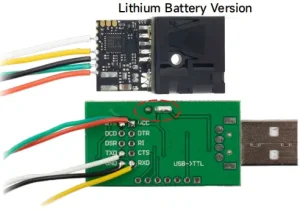
UART, RS232, and RS485 are examples of interfaces used by industrial laser distance sensors. Incorrect baud-rate settings, communication errors, dropped messages, or inappropriate polling intervals can cause missing or outdated readings in the control system.
Choose a compatible interface and verify the communication protocol, data format, update frequency, and error-handling behavior. This helps ensure that the controller receives and processes the sensor’s measurements correctly.
How to Choose a Laser Distance Sensor Based on Accuracy Requirements
The best laser distance sensor depends on the maximum measuring distance, allowable error, target characteristics, and operating environment. The following table provides a starting point for industrial sensor selection.
| Application | Example accuracy requirement | Suitable approach | Key consideration |
|---|---|---|---|
| Robotic pick-and-place | ±1–2 mm | High-precision phase sensor | Working distance and positioning tolerance |
| Crane positioning or anti-collision | ±10–20 mm | Suitable industrial distance sensor | Maximum range, response time, and mounting |
| Bridge or tunnel displacement monitoring | ±5–15 mm | Sensor matched to the measurement setup | Environmental stability and installation |
| Drone surveying or quarry monitoring | ±0.5–1 m | Long-range pulse sensor | Target distance and outdoor conditions |
| Tree-height or golf-related measurement | Around ±1 m | Suitable long-range or handheld sensor | Measurement geometry and target conditions |
These are illustrative application requirements, not guaranteed performance figures for every installation. The required sensor specification should be checked against the actual working distance and environmental conditions.
For additional guidance, see our article on laser distance sensors for industrial measurement.
A Practical Checklist for Specifying Laser Distance Sensor Accuracy
Before purchasing or integrating a sensor, answer the following questions:
- What is the maximum measuring distance? Calculate the expected error at the farthest working point using the manufacturer’s stated accuracy formula.
- What is the allowable measurement error? Define the application’s tolerance before comparing models.
- What type of target will be measured? Consider reflectivity, surface finish, transparency, and target movement.
- What are the environmental conditions? Check ambient light, operating temperature, dust, water exposure, and vibration.
- What measurement speed is required? Compare measurement frequency and response time with the application’s control requirements.
- Which communication interface is needed? Confirm compatibility with the PLC, controller, or embedded system.
- How is accuracy specified and tested? Check the manufacturer’s test conditions, calibration information, and any relevant limitations.
Following this checklist helps engineers compare laser distance sensor accuracy on a consistent basis and reduces the risk of selecting a model that meets the nominal range requirement but fails the application’s tolerance.
Frequently Asked Questions About Laser Distance Sensor Accuracy
-
How accurate is a laser distance sensor?
Laser distance sensor accuracy depends on the measurement principle, working distance, model, and test conditions. A phase sensor specified at ±(1 mm + D × 1/10000) has a stated error of ±2 mm at 10 meters and ±11 mm at 100 meters. A long-range pulse sensor may instead specify an error of ±1 meter. Always check the individual model’s datasheet.
-
What does ±(1 mm + D × 1/10000) mean?
The formula combines a constant error of 1 mm with a distance-dependent error equal to one ten-thousandth of the measured distance. At 10 meters, the total stated error is ±2 mm. At 100 meters, it is ±11 mm. The distance must be converted to the unit required by the formula.
-
What is the difference between accuracy, resolution, and repeatability?
Accuracy describes closeness to the actual distance. Resolution describes the smallest distinguishable or displayed distance increment, while repeatability describes the consistency of repeated measurements under the same conditions. A high-resolution sensor does not necessarily have equally high accuracy.
-
Are phase laser distance sensors more accurate than pulse sensors?
Phase-shift sensors are commonly used when millimeter-level measurement is required over a suitable range. Pulse time-of-flight sensors are often selected for longer distances, where a larger stated error may be acceptable. Actual accuracy depends on the specific sensor model and its operating conditions.
-
Does laser distance sensor accuracy decrease as measuring distance increases?
For sensors specified with a distance-dependent error term, the allowable error increases as the measuring distance increases. However, not all sensors use the same accuracy formula. Check the model’s datasheet and calculate the expected error at the intended operating distance.
-
Why is my laser distance sensor inaccurate in an industrial environment?
Potential causes include target reflectivity, strong ambient light, temperature changes, vibration, poor alignment, and communication or data-processing problems. Check the installation conditions against the manufacturer’s specifications before concluding that the sensor itself is defective.
-
Is a laser distance sensor with ±1 mm accuracy always better?
No. The meaning of the specification depends on its test conditions, operating distance, and error formula. A sensor with a constant ±1 mm specification may be suitable for one application, while a sensor with a distance-dependent error formula may be better suited to another. Compare the full specifications against the application’s tolerance and working environment.
Choose Laser Distance Sensor Accuracy Based on Your Application
Laser distance sensor accuracy is more than a single number on a datasheet. The specified error formula, measurement principle, working distance, target surface, environmental conditions, and data interface all influence the results you obtain in practice.
For applications requiring millimeter-level measurement over a suitable distance, a high-precision phase sensor may be the right choice. For long-range outdoor measurement, a pulse sensor may offer a more appropriate balance between range and allowable error.
Before selecting a laser distance sensor, calculate the expected error at your maximum measuring distance and confirm that the model meets your application’s tolerance and environmental requirements.
If you are specifying a sensor for industrial automation, robotic positioning, displacement monitoring, or long-range measurement, share your required range, allowable error, target material, and interface requirements with the Messcan team. These details help identify a suitable laser distance sensor for your application.