Choosing a Laser Distance Sensor for AGV Obstacle Avoidance
A systems integrator in Ningbo called me last spring about twelve AMRs that kept clipping pallet legs. Not every trip, maybe one in forty, which is the worst kind of failure: rare enough to ship, often enough to dent the client’s trust. They’d built the vehicles around ultrasonic sensors because the units were cheap and the demo video looked great. The problem was the forklift traffic. Ultrasound spreads in a wide cone, so a rack post two meters to the side registered as an obstacle directly ahead, and the vehicle braked for nothing. Then, on the runs that mattered, a thin steel strut at knee height came back as a weak echo and the AMR walked right into it.
We swapped the front pair for phase-based laser modules and the clipping stopped. Not because laser is magic, but because the beam stays a beam. That job is why I keep telling people the same four things, so here they are, written down once.
If you’re shopping for an obstacle avoidance sensor for an AGV, you are really shopping for four numbers: range, update rate, beam spread, and interface. Everything else on the datasheet is packaging. Get those four wrong and no amount of software tuning saves the vehicle.
Why AGVs Need Distance Sensing Instead of Just Bumpers
Contact bumpers are the last line, not the plan. A bumper stops the vehicle after it has already hit something, which on a 900 kg loaded AMR means the load shifted, the floor got marked, and somebody filed a report. Non-contact distance sensing gives the controller time to slow down before contact, and time is the whole product.
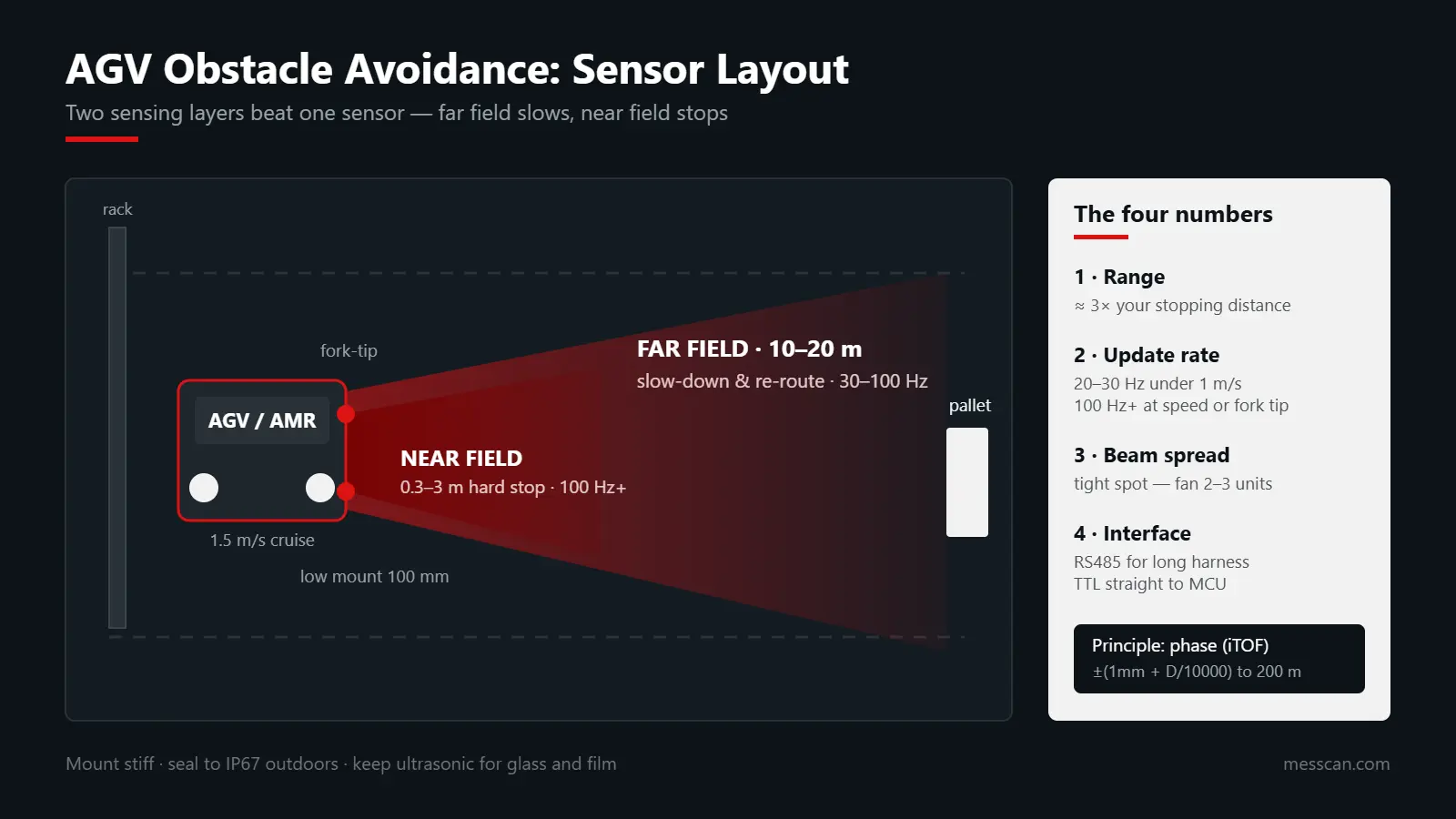
Most fleets run two layers. A far field looking three to ten meters ahead for slowing and re-routing, and a near field covering the first half meter for the hard stop. Some teams try to do both with one sensor at one height. That works right up until it doesn’t, usually with a low obstacle or a shiny floor.
The Four Numbers That Decide an AGV Obstacle Avoidance Sensor
1. Range — buy roughly three times your stopping distance
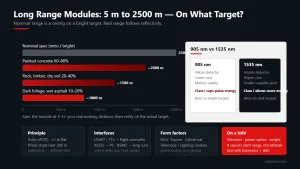
A laser distance sensor for AGV duty rarely needs 200 meters. It needs enough headroom that the controller sees a problem while it still has room to react. The rule of thumb I use: spec the range at about three times the distance you need to stop from cruise speed. That covers the dark-target penalty and the dirty-lens penalty without you having to model either.
Here’s why the margin is not paranoia. Datasheet ranges are measured against a clean, light-gray, diffuse target in a lab. The floor of a real warehouse gives you black rubber tires, shrink wrap, and polished steel. A dark surface can cut practical range by half. A sensor spec’d exactly to your stopping distance will fail on the worst target in the building, on the day someone mopped the lens.
2. Update rate — do the stopping-distance math, not the “faster is better” math
This is where most AGV builds quietly go wrong. At 1.5 m/s, a 20 Hz sensor gives you a fresh reading every 75 mm of travel. Add controller latency, and your vehicle has moved a meaningful distance on stale data. Bump that to 100 Hz and the same vehicle updates every 15 mm.
For slow warehouse AMRs under 1 m/s, 20 to 30 Hz is honestly fine. For anything crossing a shared aisle at speed, or for a fork-tip sensor doing fine positioning, look at the high-frequency modules in the 100 Hz class and up. Pay attention to the trade: pushing the sampling rate usually means averaging fewer samples per reading, which costs you a little noise performance. The accuracy spec explains that tug-of-war in detail.
3. Beam spread — one point is not a picture
A single-point laser distance sensor measures one spot. That is the honest limitation, and pretending otherwise is how vehicles hit diagonal obstacles. Typical divergence on a phase module is small enough to keep a tight spot at 5 to 10 m, which is exactly what you want for a fork-tip or a narrow-aisle guard.
Two consequences fall out of this:
- Mount two or three units and fan them slightly if you need area coverage. Three cheap single-point modules beat one expensive scanner for pure obstacle detection on a flat floor.
- Don’t expect it to see wire shelving. Thin, angled, or perforated targets can fall between samples. If your racking is mesh, test before you commit.
The tradeoff against scanning LiDAR is real, and we wrote about where each one wins in the phase vs pulse comparison.
4. Interface — TTL, RS485, or CAN, and pick before you lay the harness
On a vehicle you have three realistic choices, and the decision is mostly about cable length and noise.
| Interface | Good for | Watch out for |
|---|---|---|
| TTL / USART | Short runs, direct to an MCU or SBC | No noise immunity; keep it under a meter or two |
| RS485 / Modbus RTU | Long harness runs, industrial noise, multi-drop | Needs a transceiver; terminate the bus properly |
| RS232 | Bench testing, single-point debug | Legacy; short distance, single device |
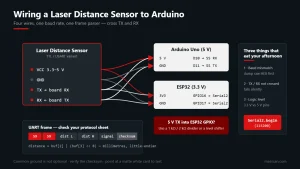
If your controller is a PLC or an industrial PC with a noisy drive cabinet nearby, go RS485. If you’re wiring straight into an ESP32 or a Raspberry Pi on the vehicle, TTL is simpler and one less board. We covered the protocol side, including Modbus RTU framing, in the RS485 vs Modbus vs CAN guide.
Which Measuring Principle Belongs on a Vehicle
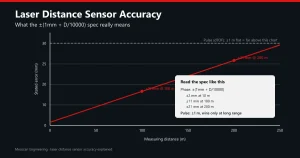
Short answer: phase, almost always. AGV work happens inside 0.03 to 200 m, where phase-shift modules hold ±(1mm + D/10000). Pulse (dTOF) modules trade that precision for kilometers, which is the right call on a survey drone and the wrong one on a warehouse floor. At 5 m, a phase unit is sitting around ±1.5 mm. A pulse unit is quoting ±1 m. You can’t navigate a 100 mm aisle gap with a meter of uncertainty.
The other reason phase wins here is size and power. A vehicle carries its own battery, and every watt of sensor draw is range you don’t get.
A Spec Map You Can Copy
| AGV job | Suggested range | Update rate | Interface | Enclosure |
|---|---|---|---|---|
| Far-field slow-down (aisle) | 10 to 20 m module | 30 to 100 Hz | RS485 | IP54 minimum |
| Near-field hard stop | 3 to 5 m module | 100 Hz+ | TTL to MCU | IP54 |
| Fork-tip pallet detection | 1 to 3 m, tight spot | 100 Hz+ | TTL | IP54, small form factor |
| Outdoor yard vehicle | 20 to 50 m | 30 Hz | RS485 | IP67 |
| High-bay overhead positioning | 20 m+ | 30 Hz | RS485 | IP54 |
Indoor warehouse work can live at IP54. The moment the vehicle sees a dock door, a washdown, or a yard, move to a sealed industrial enclosed unit with an IP67 rating. Dust on the window is the single most common cause of the “it worked in the demo” complaint.


Where to Mount It
Mounting causes more field failures than the sensor ever does. Three things I check on every install:
- Height relative to the hazard. A sensor at 600 mm misses a pallet lying flat and misses a low step. One at 100 mm misses a person’s torso. If the vehicle meets both, run two.
- Vibration. A module bolted to a bracket that rings will measure the ringing. Stiff mount, short beam, no cantilever. I have seen a perfectly good sensor read ±40 mm of pure bracket flex.
- Sunlight through dock doors. Direct sun across the lens raises the noise floor. Bump the update rate budget, add a shroud, or move the unit out of the beam path.
Laser vs Ultrasonic vs Vision for AGV Obstacle Avoidance
| Method | Strengths | Weaknesses | Fits when |
|---|---|---|---|
| Laser (ToF / phase) | Tight beam, mm-level, fast, immune to ambient sound | Struggles with glass, mesh, mirror finishes | Indoor logistics, defined aisles, precise docking |
| Ultrasonic | Cheap, sees glass and clear film, wide cone | Cone too wide for tight aisles; slow; temperature drift | Coarse presence detection, slow vehicles |
| Vision / depth camera | Rich scene data, classification | Compute cost, lighting dependent, calibration drift | Human-zone safety, semantic navigation |
The best distance sensor for AGV navigation is usually a laser distance sensor, with ultrasonic kept for the cases laser genuinely hates: glass doors, transparent film, and liquid surfaces. Fleets that run both and fuse them have the fewest incident reports in my inbox.
Mistakes I Keep Seeing
- Spec’ing to the lab number. Buy three times your stopping distance, not one times.
- One sensor, one job, one height. Low obstacles and upright obstacles are two problems.
- Forgetting the harness. RS485 with no termination resistor works on the bench and fails at 8 m next to a motor drive.
- Ignoring the beam on polished floors. Angled specular bounce sends the spot somewhere else entirely. Test on the actual floor, not a cardboard sheet.
- Treating IP54 as outdoor. It isn’t.
FAQ
What range does an AGV obstacle avoidance sensor need?
Enough to see three times your stopping distance. For a 1.5 m/s warehouse AMR that usually lands at a 10 to 20 m module, run at reduced effective range for reliability on dark targets.
How fast should the sensor update?
Match it to speed. Under 1 m/s, 20 to 30 Hz is fine. Above that, or for fork-tip positioning, use 100 Hz-class modules so the vehicle isn’t steering on stale data.
Is a laser distance sensor better than ultrasonic for an AGV?
For tight aisles and precise docking, yes — the beam stays narrow and reads to millimeters. Keep ultrasonic for glass and transparent film, which laser handles poorly.
Which interface should I use on a vehicle?
RS485 for long harness runs next to motor drives. TTL or USART for a short hop straight into an MCU or SBC. RS232 for bench work only.
Will sunlight break the readings?
Direct sun across the lens raises noise, especially through dock doors. Budget extra update rate, shroud the unit, or reposition it. Outdoor vehicles should use an IP67 sealed enclosure.
Can one sensor cover the whole vehicle?
Not reliably. Obstacles at 50 mm and obstacles at 1200 mm are different geometry problems. Most fleets run a far-field pair and a near-field pair.
Conclusion
Pick a laser distance sensor for AGV work by the four numbers — range with a 3× margin, update rate matched to speed, tight beam spread, and an interface that survives your harness. Mount it stiff, seal it if there’s dust or weather, and keep ultrasonic around for glass. Do that and the “one in forty” clipping goes away.
If you’re sizing a fleet right now, send me the cruise speed, the stopping distance, and the worst surface in the building. I’ll point you at the module, not the brochure. Start with the laser distance measurement modules overview, or the 2026 buying guide if you’re still comparing principles.
References
ISO 3691-4 — Industrial trucks / driverless trucks safety requirements. https://www.iso.org/standard/71207.html
IEC 60825-1 — Safety of laser products, classification of laser radiation. https://www.iec.ch