A survey customer in Inner Mongolia ordered our 2500 m module, mounted it on a fixed mast, and called back a week later saying it wouldn’t range past 900 m. We asked what he was aiming at. Scrub brush on a hillside, mid-morning, low sun behind the target. That’s roughly a 15% reflector at a kilometre, and no module on earth holds its nominal maximum on that. He hadn’t bought a bad unit. He’d bought the right unit against the wrong assumption.
The nominal range on the box is measured against a high-reflectivity target under clean conditions. Everything about a long range laser rangefinder module comes back to that one sentence, so let’s start there.
What “Long Range” Actually Buys You
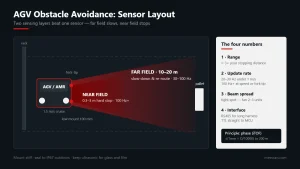
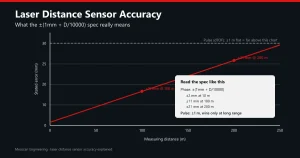
In this product family, long range means the pulse (dTOF) line: 5 m to 2500 m, typically at 905 nm, quoted at ±1 m. The precision phase line stops around 200 m and holds ±(1mm + D/10000). Those are not better and worse versions of the same thing. They are different instruments, and the physics that gives you kilometres is the same physics that costs you millimetres.
| Phase (iTOF) line | Pulse (dTOF) line | |
|---|---|---|
| Typical range | 0.03 – 200 m | 5 – 2500 m |
| Stated accuracy | ±(1mm + D/10000) | ±1 m (flat) |
| Best at | Millimetre positioning | Kilometre reach |
| Typical host | AGV, crane, machine | UAV, mast, vehicle, handheld |
If your job is under 200 m and needs millimetres, you are on the wrong page — start with the phase vs pulse comparison instead. If your job is 800 m of quarry face, keep reading.
The Rule That Saves Every Long-Range Project
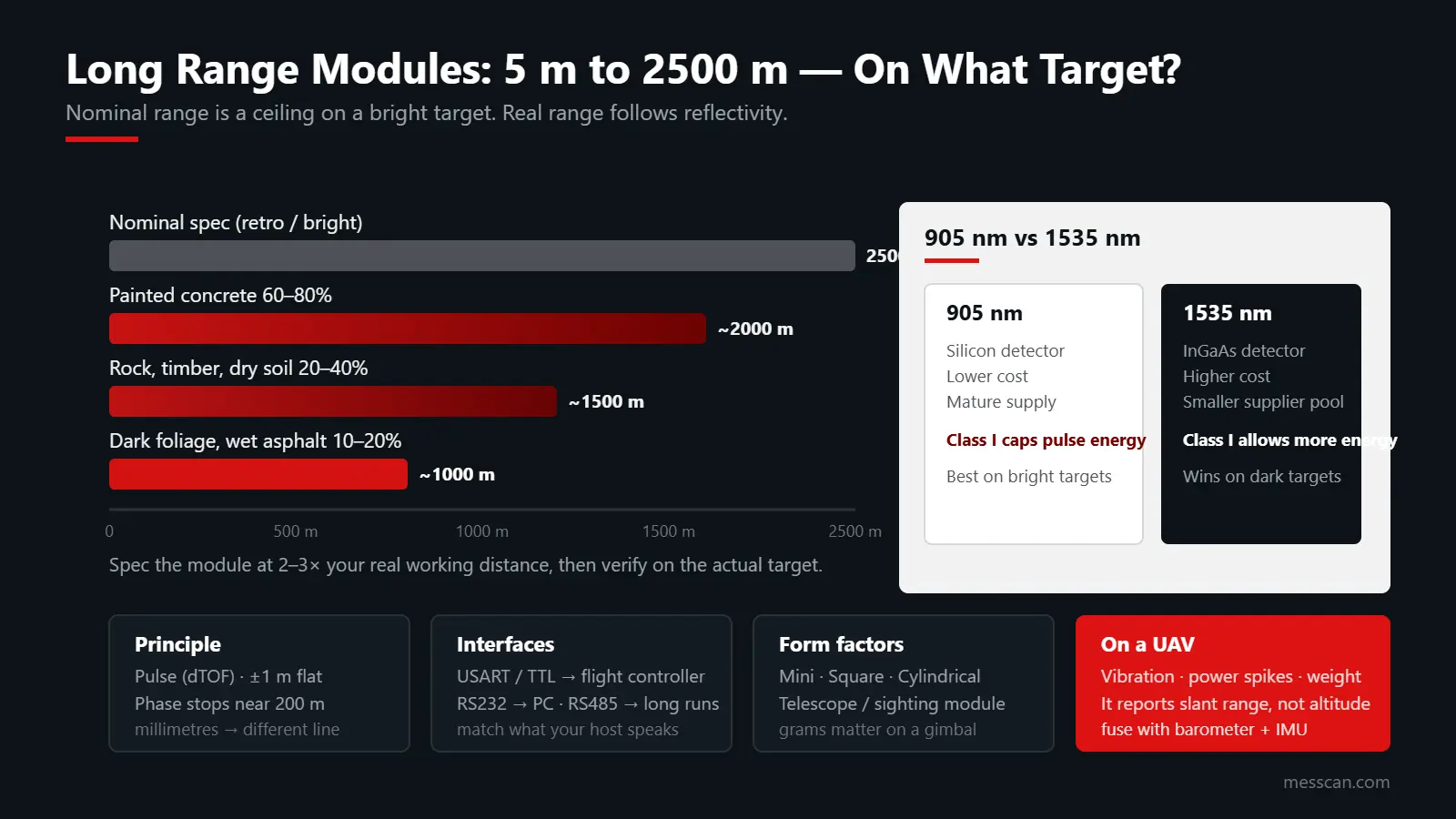
A long range module meets its nominal maximum only on a bright, diffuse, high-reflectivity target. Real targets are darker, and the penalty is not linear — it stings.
| Target | Rough reflectivity | Practical factor on max range |
|---|---|---|
| Retroreflective tape / prism | Very high | Near nominal |
| Painted concrete, light gray | 60–80% | ~0.8× |
| Timber, dry soil, rock | 20–40% | ~0.6× |
| Dark foliage, wet asphalt | 10–20% | ~0.4× or worse |
So a 2500 m module pointed at dark scrub behaves like a 1000 m module. That is not a defect; it’s the physics of a returning photon budget. The practical move is to spec the module at two to three times the real working distance, then verify on the actual target before you freeze the mechanical design. Every long-range project I’ve seen fail did so in this step, not in the electronics.
Two more environmental taxes:
- Sun and haze. Strong ambient light raises the noise floor; haze and rain scatter the beam. Budget margin for the worst hour of the day, not the best.
- Angle of incidence. A beam hitting a face at a steep angle throws most of the energy away from the receiver. Perpendicular shots go farthest.
905 nm vs 1535 nm: Wavelength Changes the Budget
This is the second decision, and it’s mostly about eye safety versus power.
905 nm — silicon detectors, mature supply chain, lower cost. The limit is that the eye transmits near-infrared readily, so the permissible pulse energy for Class I is low. You reach far by making the optics efficient and the timing sharp.
1535 nm — the eye’s cornea absorbs this band before it reaches the retina, so Class I permits far more pulse energy. More energy per shot means better performance on dark targets and in haze. The cost is an InGaAs detector, which is genuinely more expensive, and a smaller supplier pool.
A plain-English version: 905 nm is the value choice, 1535 nm is the performance choice on hard targets. For a UAV flying over dark terrain at a kilometre, the 1535 nm premium often pays for itself in reliability. For a fixed installation aiming at painted structures, 905 nm Class I is usually plenty.
Whichever you pick, confirm the laser class on the specific model’s datasheet and keep the classification documentation with the machine file. The basis for those classes is IEC 60825-1, and any integrator shipping a system should be able to produce it on request.
Interfaces and Form Factor
A drone laser rangefinder module lives or dies on three integration details, and none of them is range.
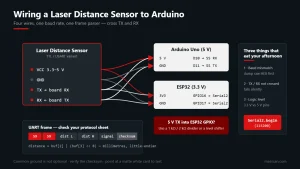
Interface. USART / TTL for a short hop into a flight controller or MCU; RS232 where you want a simple point-to-point link with a PC; RS485 where the cable run is long or the environment is electrically noisy. Pick the one your host already speaks. Adapters cost you weight and a failure point. The protocol side is covered in the RS485 vs Modbus vs CAN guide.
Form factor. The same ranging engine comes in several mechanical packages:
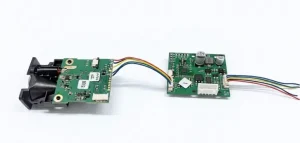
- Mini / featherweight — the TS1224-Mini class, built for gimbal and small-UAV payloads where grams matter
- Square module (PTFS) — easiest to bolt into an enclosure; good heat path
- Cylindrical — drops into a tube or a lens housing
- Telescope / sighting module — for handheld and observation builds where the operator needs an optical channel
Trigger rate. Check the maximum measurement frequency against your platform’s speed. A fixed mast reading once a second has different requirements than a vehicle sampling its approach at 20 Hz.
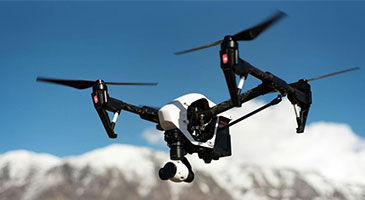
UAV and Drone Integration Notes
Flying a rangefinder is a different discipline from bolting one to a wall. Four things bite people:
- Vibration. Airframe vibration loosens connectors and smears the beam. Stiff mount, strain relief on the cable, and a re-torque schedule.
- Power. Each measurement burst draws a current spike. Size the supply for the spike, not the average, or you’ll get dropouts at exactly the moment you trigger.
- Weight and balance. A heavier module forward of the CG shortens flight time. Every gram on the gimbal is flight time you don’t get.
- Altitude reference. For UAV distance measurement at 2500 m, remember you’re measuring slant range to whatever the beam hits. Over flat ground that’s close to altitude; over a slope or a treeline it is not. Fuse it with the barometer and IMU rather than trusting it alone.
One honest caveat: any airborne installation has to meet the operator’s own regulatory obligations for the airspace. We build the module; the operator owns the compliance file.
Where These Modules Actually Get Used
| Application | Typical range | What matters most |
|---|---|---|
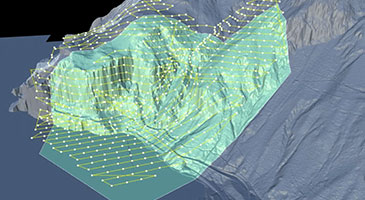
| UAV / drone survey and mapping | 300 – 2500 m | Weight, slant-range awareness, trigger rate |
| Fixed perimeter and border monitoring | 500 – 2500 m | Reliable ranging on low-reflectivity ground |
| Port and container positioning | 50 – 500 m | Repeatability, weather sealing |
| Vehicle detection and speed enforcement support | 100 – 1000 m | Fast trigger, stable mount |
| Forestry and terrain profiling | 200 – 1500 m | Dark-target performance (1535 nm helps) |
| Industrial stockpile profiling | 20 – 300 m | Scanning integration, dust tolerance |
Note the shape of that table: most real jobs sit well below the headline number. That’s expected. The headline is the ceiling under ideal conditions, not the working point.

Selection Checklist
- Write down the real target and its reflectivity, not the distance. Dark foliage at 800 m is a harder job than concrete at 1500 m.
- Multiply your working distance by 2–3, then pick the module whose nominal range clears it.
- Choose wavelength on target darkness. 905 nm for bright, cooperative targets; 1535 nm for dark terrain or haze.
- Confirm the laser class and file the classification documentation.
- Match the interface to what your host already speaks.
- Pick the mechanical package that fits your enclosure — mini, square, cylindrical, or telescope.
- Verify on the real target before freezing the design. Bench tests against a white card prove nothing about a hillside.
FAQ
What is the longest range available?
Our pulse line reaches 2500 m nominal (TS1224-Mini class, 5–2500 m, 905 nm, Class I). Treat that as a best-case ceiling on a high-reflectivity target, not a working distance.
Is a “laser range finder module” the same thing as a “laser rangefinder module”?
Yes. Two spellings of one product category — a compact pulsed-laser distance measuring engine for integration. If you searched the spaced version, you’re in the right place.
How accurate is long-range measurement?
Typically ±1 m, flat across the range. That’s inherent to timing a single pulse over kilometres. If you need millimetres, you want the phase line, which stops near 200 m.
Is a laser ranging sensor the same as a laser distance sensor?
Loosely, yes — both measure distance with light. In this catalog, “ranging sensor / rangefinder module” points to the long-range pulse line; “distance sensor” points to the high-precision phase line. The distinction matters when you’re choosing.
Can I run one on a drone?
Yes, and it’s a common build. Watch weight, power spikes on the measurement burst, vibration isolation, and remember the module reports slant range.
905 nm or 1535 nm?
905 nm for cost-sensitive jobs with cooperative, light-colored targets. 1535 nm when you need more pulse energy for dark targets or haze, and the budget allows the InGaAs detector.
What about rain and fog?
Both attenuate the beam and shorten practical range. Budget margin for the worst weather you must operate in, and consider 1535 nm if haze is routine.
Conclusion
A long range laser rangefinder module is chosen on target reflectivity, not on the headline number. Multiply your real working distance by two or three, pick the wavelength that survives your worst target, match the interface to your host, and verify outdoors before the design locks. That sequence has never failed me; skipping step seven has, more than once.
Tell me the farthest real target, what it’s made of, and what the host device speaks. I’ll point you at the module rather than the spec sheet. Start with the laser distance measurement modules overview, or the 2026 buying guide if you’re still choosing between principles.
References
IEC 60825-1 — Safety of laser products, classification of laser radiation and accessible emission limits. https://www.iec.ch
Laser safety — wavelength-dependent ocular hazard and exposure limits. https://en.wikipedia.org/wiki/Laser_safety